
The short answer
Why did a Japanese motorcycle company and an Indian bicycle group need one another? Hero Honda’s formation joined different capabilities under a shared company. The 1984 partnership and 1985 production start explain its origins; later leadership explains how it developed.
Chronology
A timeline of the turning points
An Indian manufacturing platform
The Hero group develops bicycles, components and commercial relationships.
Hero Honda established
Hero and Honda form a motorcycle production and sales venture.
Dharuhera production
The new factory starts making the CD100.
Twenty-year milestone
Honda and Hero mark cumulative production of ten million motorcycles.
Hero supplied a business platform, not an empty market
The Munjal family’s Hero businesses had developed bicycles, components and manufacturing relationships before the motorcycle venture. Brijmohan Lall Munjal was central to this earlier growth. Hero brought an industrial organisation, knowledge of Indian customers and the capacity to develop sales and supply relationships.
The distinction matters because the new venture was neither an isolated foreign factory nor the invention of an entire Indian two-wheeler industry. Existing manufacturers and transport choices already shaped the market. The partnership sought a place within that setting by combining specific capabilities, with a product and service network that would have to earn customers over time.
Honda needed a local manufacturing route
Honda’s historical account places its entry within the restrictions and opportunities of the period. Imported finished vehicles were not the chosen route, and participation with Indian partners offered a way to manufacture locally. Honda describes taking the roles of management partner, investor and technology and product licensor.
In 1984 it established Hero Honda for motorcycles and a separate Kinetic Honda venture for scooters. These were distinct companies and product arrangements. Hero Honda’s later success should not lead readers to treat every Honda two-wheeler sold in India as part of that one joint venture. Corporate structure determined who could manufacture, sell and develop each business.
Sources for this section: [5]
Formation in 1984 preceded production in 1985
The partners established Hero Honda in 1984; production of the CD100 began at Dharuhera in Haryana in 1985. Honda’s 2004 anniversary release explicitly separates these dates. A company needs a legal and commercial framework before a factory can reliably produce a finished motorcycle.
Honda’s later dissolution release records an initial 26 per cent holding for Honda and 26 per cent for the Indian partners. Equal partner stakes did not mean that each owned half of every outstanding share. Keeping the percentages precise avoids confusing an equal partnership arrangement with a wholly owned private company divided into two identical halves.
The motorcycle depended on a wider production system
The initial CD100 used a small four-stroke engine in an everyday motorcycle. Technology and product design were only part of the offer. A customer also needed a vehicle available at a reachable dealer, a supply of parts and someone able to service it. Hero’s account describes ancillary suppliers locating near the first plant to support dependable parts supply.
The combined system linked Honda’s engineering with local production, suppliers and market knowledge. That helps explain the venture’s durability more clearly than crediting one slogan or one leader. Factory employees, component makers, distributors and mechanics converted the agreement into a product that could be bought and maintained repeatedly.
Later scale did not change who founded the venture
At the December 2004 anniversary, Honda reported ten million motorcycles produced cumulatively and five million Splendor units. Takeo Fukui and Brijmohan Lall Munjal attended the celebration. These were later production milestones, not quantities present when the venture was established.
Pawan Munjal became an important later leader, serving as managing director and CEO and participating in the 2010 separation negotiations. His career belongs in the longer company history, but he should not replace Brijmohan Lall and Honda as the founding participants. The move to Hero MotoCorp in 2011 would eventually test which capabilities could continue after the original ownership partnership ended.
Continue the chronology
Related history guides
Biography context
Explore Dharuhera, Haryana, India through connected lives
Connected biographies
The partnership before its later executive generation
1954–present
Pawan Munjal
Hero MotoCorp executive chairmanPawan Munjal developed his career within the Hero manufacturing businesses and became a senior leader of Hero Honda. He helped negotiate the Honda separation announced in 2010 and the transition to Hero MotoCorp in 2011. He became chairman in 2015 and is executive chairman in the reviewed company record.Read biographyQuick answers
Common questions
- Was Hero Honda formed in 1984 or 1985?
- It was established in 1984 and began motorcycle production in 1985. The dates refer to different stages.
- Did Honda own half of all the company’s shares?
- The cited Honda record gives 26 per cent for Honda and 26 per cent for the Indian partners, not 50 per cent of all shares each.
- Was Pawan Munjal the original founder?
- No. The founding history centres on the Hero group led by Brijmohan Lall Munjal and Honda. Pawan’s documented role was in later executive leadership.
Primary and institutional sources
How this history was checked
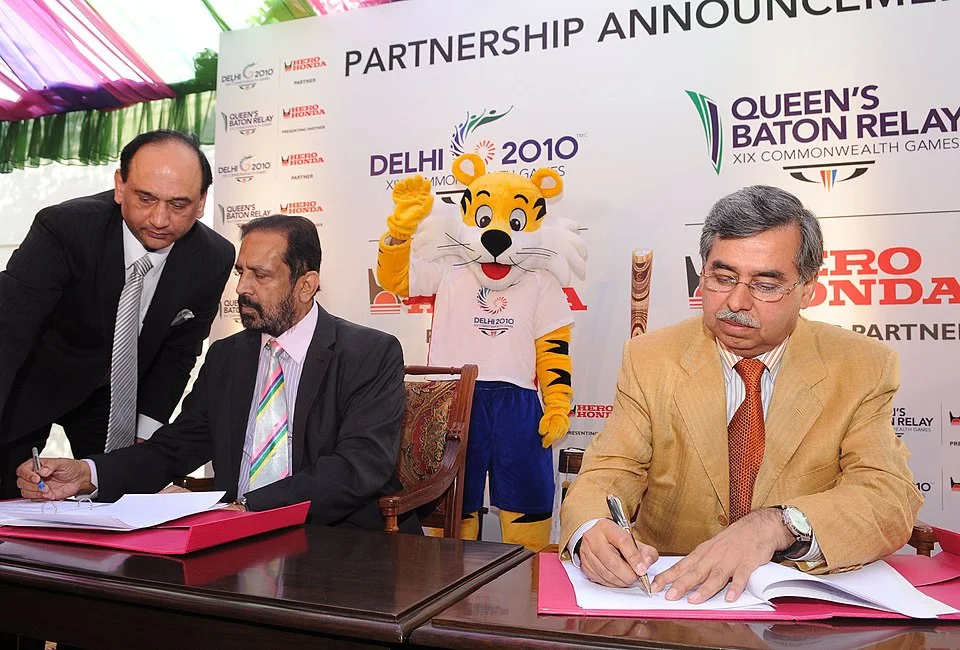
Honda’s historical and contemporary anniversary records establish formation, production and partner roles. Hero’s account and independent reporting add the Indian manufacturing setting. Pawan Munjal’s photograph is explicitly later context, not evidence of his participation in the founding event. This article was reviewed on 23 October 2026.
- Hero MotoCorpCurrent board and leadership: executive chairman and separate operating offices
- Bahadur Chand InvestmentsGovernance filing, March 2025: Pawan Munjal birth date and DIN
- UK Companies HouseHero Future Energies Global directors: Indian nationality and October 1954 birth month
- Hero Corporate ServiceOur Heritage: bicycle business, 1984 joint venture and supplier network
- Honda75 Years of Honda History: India, local partners, Dharuhera and CD100 production
- HondaHero Honda twentieth anniversary and production milestones, 10 December 2004
- HondaDissolution agreement and new product licences, 16 December 2010
- Hero MotoCorpAnnual Report 2010–2011: share transfer, legal name, brand and licence accounting
- Hero MotoCorp2016 AGM notice: Pawan Munjal executive tenure and June 2015 chairmanship
- Rediff / Business StandardCan Hero live up to its name? Contemporary brand and R&D analysis, August 2011
- Rediff / Business StandardBrijmohan Lall Munjal: family origins, partnerships, branding and succession, June 2015
- Rediff / Business StandardDifficult road ahead for Honda: separate subsidiary and post-split competition, March 2011
- PTI / The WeekDelhi High Court quashes DRI summons, 24 July 2024
- Hero FinCorpKey Information Document, 11 March 2026: disclosed tax appeals and ED proceedings
- Delhi High Court / Indian KanoonPawan Kant v. Directorate of Enforcement, 11 February 2026: property substitution order
- Ministry of Youth Affairs and Sports / Wikimedia CommonsPIB 26195: complete 2009 photograph, official authorship and EXIF credit
- Press Information BureauPrimary accurate-reproduction permission; third-party material excluded