
The short answer
Does an employer’s support for a benefit fund establish that joining it was free and voluntary?
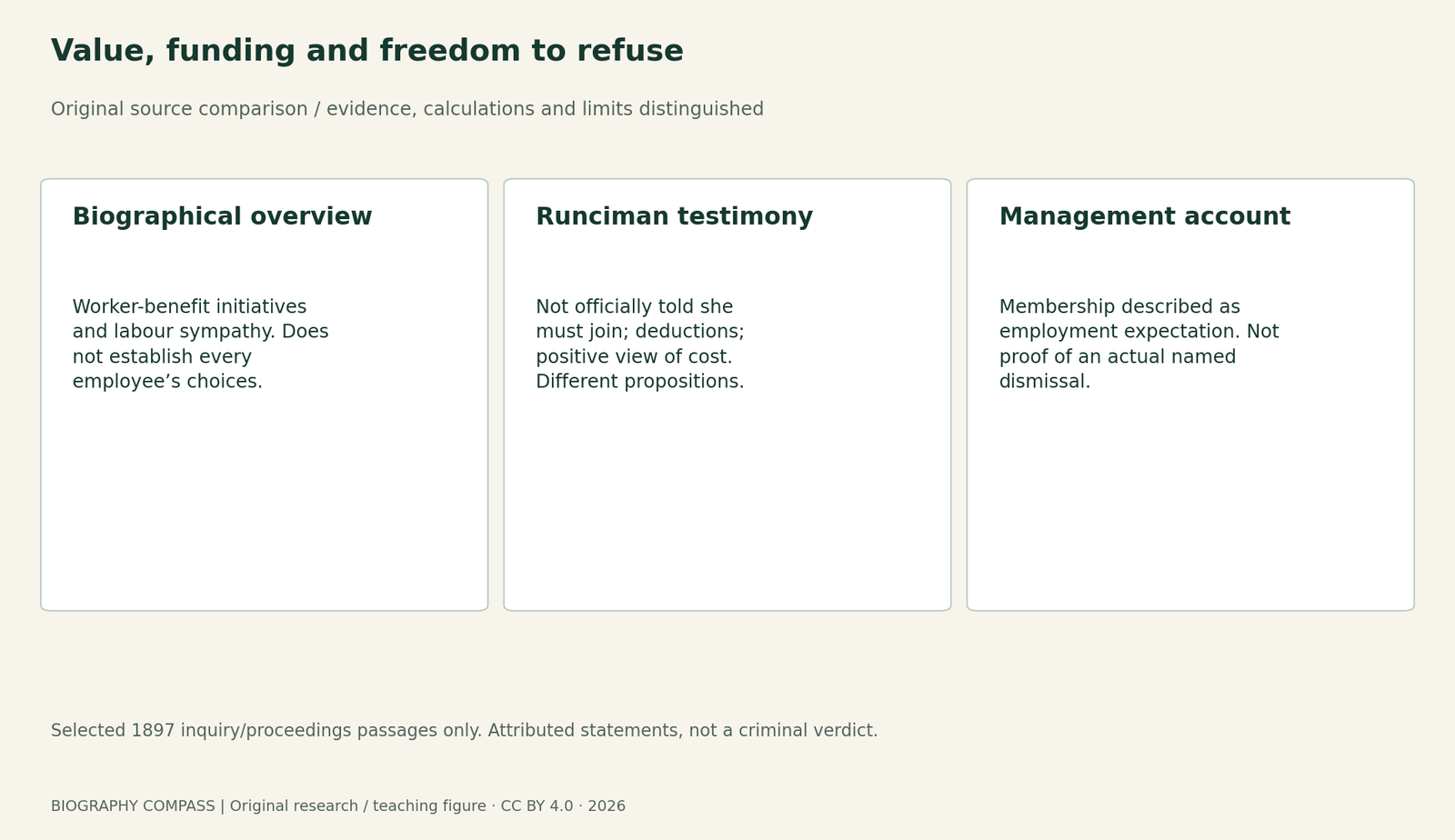
Original source comparison
What does each voice establish?
A positive experience and an employment condition can both belong in the record.
| Record | What it supports | What remains unestablished |
|---|---|---|
| DNZB overview | A historical account of benefit initiatives and labour sympathy. | Every employee’s experience or the complete rules of all funds. |
| Runciman testimony | Her reported understanding, deductions and positive view of the benefit. | That nobody faced an employment condition or that all costs were employer-paid. |
| Helean/proceedings report | Management’s attributed description of funds and membership expectations. | A criminal verdict or proof of an actual named dismissal. |
Chronology
A timeline of the turning points
Medicine-fund account
DNZB dates an employee medicine initiative to this year.
Union support
Biography records Hallenstein’s support for a tailoresses’ union.
Commission evidence
Named employee and manager passages examine membership, deductions and funds.
Contemporary report
Otago Witness reports the factory-society proceedings.
A generous reputation is a starting question
The DNZB describes Bendix Hallenstein’s employee-benefit work and support for labour organisation. It records a fund associated with medicine and his public support for a tailoresses’ union. Those are significant elements of his reputation. They do not automatically establish how every workplace scheme operated, whether each employee could decline to join or who paid its subscriptions. The 1897 Royal Commission on Private Benefit Societies asks more specific institutional questions. Reading its evidence beside the biography allows support for workers and employee choice to be examined as related but distinct matters.
Identify the workplace and the speaker
The relevant testimony concerns the New Zealand Clothing Factory, not every employer examined in the Commission’s long report. The indexed passages include tailoress Jane Elizabeth Runciman and factory manager Patrick Joseph Helean. Their positions matter: each could describe a different part of the arrangement, and an answer about one person’s experience does not establish a universal policy. The selected record also contains questions about contributions and the handling of funds. This guide uses those named passages only; it does not claim to have read the complete inquiry or the experience of every employee.
Sources for this section: [2]
Not being told to join differs from being able to refuse
In questions 202–209, Runciman said she had not been officially told she must join. She nevertheless knew of the society before starting work and described deductions from wages. She also regarded the benefit as cheap. These statements can coexist: an employee might value a scheme while its membership was expected as part of employment. The evidence should not be flattened into either universal enthusiasm or universal opposition. Ask separately what was explained, what was deducted, what choice existed and what would happen if an employee objected.
Sources for this section: [2]
Management testimony adds a question about consequences
Helean answered questions about the society’s money and its relationship with the firm. The contemporary Otago Witness account reports his statement that an employee demanding wages in full would be dismissed, and that employment was understood to include society membership. That is consequential testimony, but it remains an attributed account of the arrangement, not a criminal conviction or a finding about all benefit societies. It also does not establish that any particular named employee was actually dismissed. Distinguishing a stated condition from an observed event keeps the historical claim within its evidence.
Original exercise: grade a fictional museum caption
A fictional caption reads: “Hallenstein paid every cost himself, and every worker freely chose the fund; Runciman’s satisfaction proves there were no compulsory deductions.” Produce three evidence cards. For each, identify the claim, a relevant speaker or source and the conclusion that can actually be supported. Then list two additional records needed to test whether an employee could refuse without losing work. Finally, explain why an account of free medicine cannot simply be substituted for the rules of every related benefit arrangement. Do not assume that all funds, benefits or employers in the inquiry were identical.
Reference answer: separate value, funding and consent
Runciman’s positive assessment supports her reported view of the benefit; it does not prove the absence of deductions or an unrestricted right to refuse. Her testimony explicitly describes payroll deductions. Helean’s reported employment condition is evidence against confidently calling membership freely optional, while it does not prove a particular dismissal occurred. The biography’s medicine-fund description and the inquiry’s society arrangements should retain their own scope. Written rules and employment terms, together with payroll or grievance records, would help test actual choices and consequences. Satisfaction, contribution and freedom to decline are separate propositions.
Write a conclusion that preserves several voices
The records support an employer associated with worker-benefit initiatives and a workplace society whose membership and deductions were questioned in an inquiry. They do not require a single verdict on Hallenstein’s character or a claim that all workers experienced the arrangement alike. The biography supplies an overview, the transcript gives attributed answers and the newspaper reports proceedings for contemporary readers. Their different purposes are useful when kept visible. A careful history can recognise support and still investigate power, consent and institutional design, without replacing testimony with praise or converting an inquiry into a criminal judgment.
Continue the chronology
Related history guides
Did Laidlaw’s Catalogue Prove Availability?
Does listing a product establish that a customer could actually obtain it at the printed price?
Read the timeline1960s–1970; later historical accountsWho Turned a Humidifier Idea into a Product?
Which records support credit for a medical product’s development, and which claims require different evidence?
Read the timelineBiography context
Explore New Zealand through connected lives
Connected biographies
Business lives in context
1835–1905
Bendix Hallenstein
Merchant, clothing manufacturer and retailerBendix Hallenstein moved from goldfields trading into clothing manufacture and retailing, and became involved in public office and debates about workers’ conditions.Read biographyQuick answers
Common questions
- Can a useful benefit still raise a consent question?
- Yes. The value of a benefit and the ability to decline it are different issues.
- Does the inquiry prove a worker was dismissed?
- The inspected passage reports a stated consequence of refusal; a particular dismissal would need its own record.
Primary and institutional sources
How this history was checked
Compare the stated source scopes. The original exercises and reference answers are teaching material; fictional records are labelled. No complete catalogue, inquiry, clinical archive or full economic report was read. This article was reviewed on 27 October 2026.
- Gordon Parry, Dictionary of New Zealand Biography / Te AraHallenstein, Bendix
- New Zealand Royal Commission / AJHR, Papers PastPrivate Benefit Societies: Royal Commission report and evidence, H–2,1897 Session II
- Otago Witness / Papers Past, National LibraryPrivate Benefit Societies, Otago Witness,3 June 1897