
The short answer
Gulf NC’s short opening announcement contains 127.4 MW, 90.0 MW, 17 MW and 24.0 TPH. These numbers describe different aspects of one plant. The useful question is which quantities can be compared, which require another physical assumption, and which additional measurements would be needed to reconstruct an energy balance.
Compare the evidence
What each record can establish
Keep the quantity, institution and historical scope attached to the statement.
| Record or example | Evidence supplied | Limit on the inference |
|---|---|---|
| Opening release | Installed MW, two electrical supplies and a steam flow. | No complete dispatch or heat-balance dataset. |
| Ownership schedule, if obtained | A specified stake and reporting boundary. | Equity attribution would not add physical plant capacity. |
| Fictional model | An explicit time, share and enthalpy. | Results apply to the exercise, not unreported historical conditions. |
Chronology
A timeline of the turning points
Gulf Electric leadership
Sarath’s biography records this earlier company tenure.
Gulf NC commercial opening
Short release supplies the three electrical figures and steam flow.
Additional assumptions supplied
One hour, 70% ownership and 2,300 kJ/kg are fictional teaching inputs.
Read the nouns as carefully as the numbers
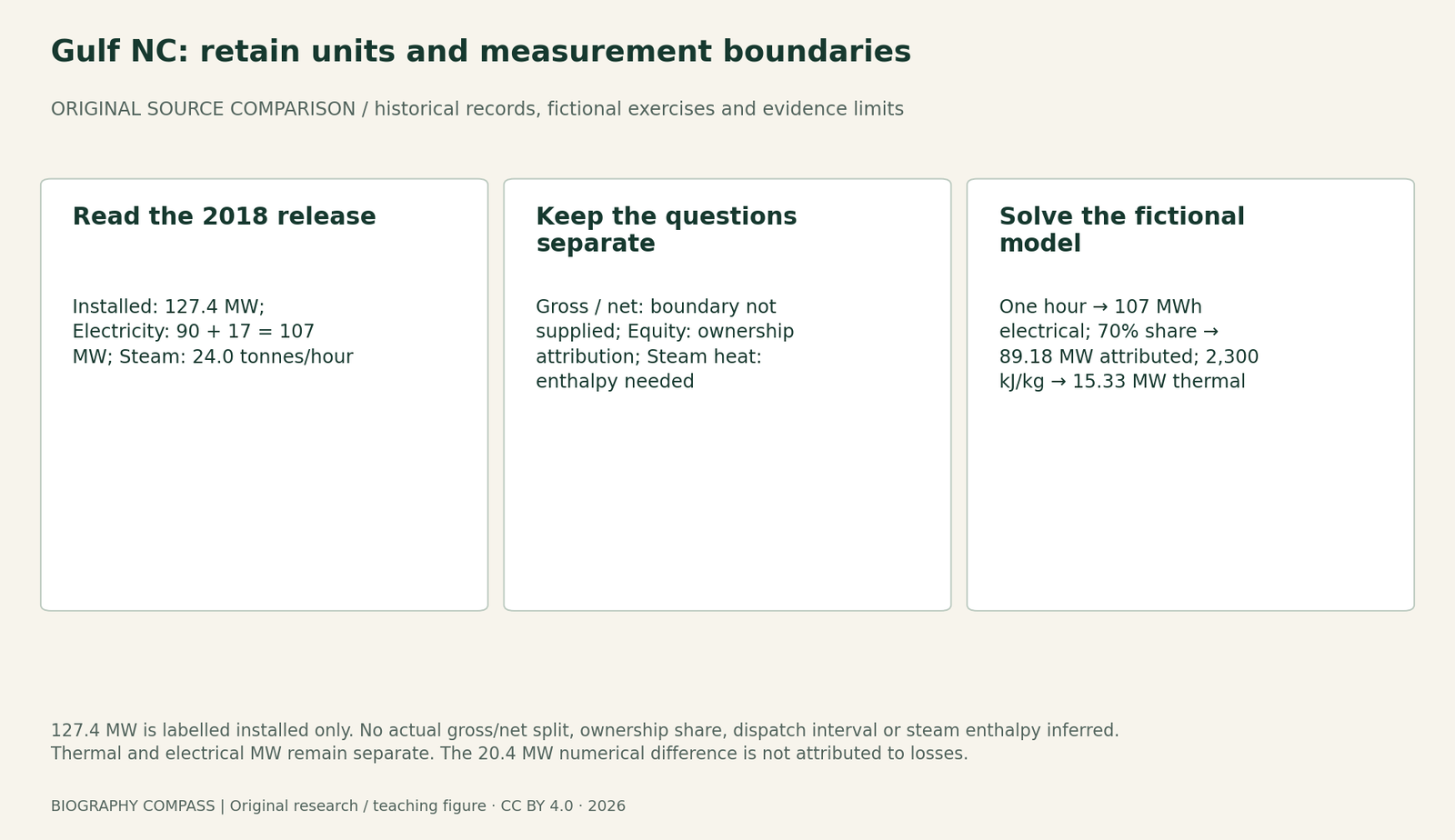
Gulf’s 1 March 2018 announcement calls 127.4 MW the plant’s installed capacity. It separately reports 90.0 MW of electricity to EGAT and 17 MW of electricity to industrial users. It also reports 24.0 tonnes per hour of steam for industrial users. The site is identified as Nonsi, Kabin Buri, Prachin Buri. This is a short commercial-opening record, not a complete design report or a time series of measured dispatch.
The two stated electrical supplies sum to 107 MW. They are not additional generating plants to be added to 127.4 MW. The 20.4 MW difference between the stated capacity and those supplies does not, by itself, establish auxiliary consumption, reserve capacity or a technical loss. The announcement does not provide the definitions or simultaneous measurements needed to choose among such explanations.
Sources for this section: [1]
Separate physical capacity from ownership
Three common labels answer different questions. Gross capacity describes generating output before specified internal uses; net capacity accounts for those uses under a stated measurement boundary. Equity capacity allocates a project’s reported capacity according to an ownership interest. An equity calculation changes accounting attribution, not the number of turbines physically installed.
The opening release does not label 127.4 MW gross, net or equity. Its safe description is therefore the one actually supplied: installed capacity. Sarath Ratanavadi’s Gulf leadership gives biographical context, but neither his office nor a group name establishes a particular ownership fraction in this project. A shareholder schedule and the capacity definition would be needed for a historical equity-capacity claim.
Steam needs a heat assumption
Tonnes per hour is a mass-flow rate. Megawatts measure a rate of energy transfer. Steam’s heat output therefore cannot be obtained merely by adding 24 to an electrical MW figure. To calculate a thermal rate, a model needs the energy delivered per unit mass between specified inlet and return conditions.
Use the relation thermal power = mass flow × delivered specific enthalpy. This is a dimensional calculation, not a claim about Gulf NC’s actual steam conditions. The release does not supply those conditions. Even after converting a hypothetical steam flow to thermal MW, a reader should keep thermal and electrical outputs labelled separately; a bare combined number would conceal the different forms and usefulness of energy.
Sources for this section: [1]
Exercise: audit a proposed diagram
A fictional diagram uses the release’s numbers but adds three assumptions: the two reported electrical supplies persist together for one hour; a hypothetical investor owns 70% of the plant; and each kilogram of delivered steam transfers 2,300 kJ of useful heat. Its caption proposes “127.4 + 90 + 17 + 24 = 258.4 MW owned and delivered.” Identify each error, then calculate the electrical energy, illustrative equity capacity and thermal output separately.
Keep the historical figures and fictional assumptions in different columns. In particular, the 70% share and steam enthalpy are invented teaching inputs. They must not become facts about Gulf NC, Gulf’s actual stake or the founder’s personal assets.
Sources for this section: [1]
Reference answer and the next record to request
The proposed sum double-counts capacity and its reported supplies, adds a mass-flow rate to power, and confuses project output with ownership attribution. Under the supplied one-hour assumption, electrical energy is (90 + 17) × 1 = 107 MWh. The fictional equity allocation is 127.4 × 0.70 = 89.18 MW; the physical installed capacity remains 127.4 MW.
For heat, 24 tonnes/hour is 24,000/3,600 = 6.6667 kg/s. Multiplying by 2,300 kJ/kg gives 15,333.3 kJ/s, approximately 15.33 MW thermal. Report this separately from 107 MW electrical. To turn the exercise into an account of actual plant performance, request contemporaneous dispatch data, gross/net definitions, auxiliary consumption, steam conditions and an ownership schedule. The short opening record alone cannot supply them.
Sources for this section: [1]
Continue the chronology
Related history guides
What does AIS’s paired 2 × 15 MHz mean?
Compare AIS licence tables and frequency ranges, then map paired uplink and downlink bands without mistaking spectrum width for download speed.
Read the timeline2022–2025 records · distinct operating permissionsDoes an airline certificate cover its airport?
Compare Bangkok Airways’ airline certificate with Samui’s aerodrome record and 2025 transfer, then test who holds each permission and what it covers.
Read the timelineBiography context
Explore Thailand through connected lives
Connected biographies
People connected with this history

Business career from 1994
Sarath Ratanavadi
Engineer and Gulf business organiserSarath Ratanavadi built a career in Thai power projects before leading the Gulf businesses into telecommunications and digital infrastructure.Read biographyQuick answers
Common questions
- Is 24 TPH equivalent to 24 MW?
- No. It is a mass-flow rate. A heat calculation also needs delivered energy per kilogram and a stated measurement boundary.
- Does the 20.4 MW gap prove plant losses?
- No. The release does not define the figures sufficiently or establish simultaneous measurements to infer that explanation.
Primary and institutional sources
How this history was checked
Selected primary records and identified company-linked publications support this historical comparison. Fictional exercises are labelled, and each source retains its historical context. This article was reviewed on 28 October 2026.