
The short answer
Frances Perkins chaired the committee that developed the Roosevelt administration’s economic security proposals. The resulting law joined several forms of insurance and public assistance, while leaving substantial gaps. Its passage in 1935 and the first monthly retirement payments in 1940 mark different stages of the story.
Chronology
A timeline of the turning points
Committee on Economic Security established
Executive Order 6757 placed the secretary of labor in the chair and provided for an advisory council, technical board and executive director.
Recommendations sent to Congress
Roosevelt transmitted the committee’s report and recommended economic security legislation.
Perkins explains the proposal
A national radio address presented the administration’s social insurance plans to the public while Congress considered the bill.
Social Security Act enacted
Roosevelt signed legislation combining federal old-age insurance, federal-state unemployment insurance and several assistance and welfare programs.
Old-age insurance contributions begin
Workers and employers began paying the payroll taxes supporting the new retirement insurance system.
Program amended before monthly payments
Congress added dependents’ and survivors’ benefits and advanced the monthly-payment schedule from 1942 to 1940.
First monthly retirement check
Ida May Fuller’s check for $22.54 became the first in the recurring monthly benefit program.
Why did economic security become a federal problem?
The Great Depression exposed how quickly unemployment and lost savings could overwhelm families, charities and local governments. Earlier assistance and pension arrangements existed, but protection depended heavily on location, occupation and family resources. Increasing reliance on wages meant that an interruption of earnings could remove a household’s main means of support.
The Committee on Economic Security’s report framed insecurity as a problem extending across the life course. It considered children, unemployed workers, illness and old age together, while recognizing that an immediate legislative program would be narrower than its ambitions. The report’s argument was preventive as well as remedial: government should organize protection against foreseeable losses instead of relying entirely on emergency relief after hardship arrived.
What did Perkins lead, and who else shaped the plan?
Executive Order 6757 created the Committee on Economic Security on 29 June 1934 and made the secretary of labor its chair. Perkins therefore led the Cabinet-level decision-making body. The order also provided for an Advisory Council, a Technical Board and an executive director, establishing several channels through which evidence and proposals could reach the committee.
Edwin Witte directed the staff’s studies; Arthur Altmeyer led the Technical Board. Advisers and specialists investigated different hazards and debated possible systems. Perkins coordinated political leadership and advocacy, including a national radio explanation in February 1935. Calling her a leading architect recognizes this role without assigning her sole authorship. Roosevelt selected priorities, specialists developed proposals, and legislators changed the administration’s recommendations.
What did Congress enact on 14 August 1935?
The Social Security Act was a collection of related programs. Federal old-age insurance linked future retirement benefits to covered employment and contributions. A different title supported state old-age assistance for people in need. The law also established a federal-state unemployment compensation structure and grants for dependent children, maternal and child welfare, public health and assistance to blind people.
These distinctions matter when reading the phrase Social Security in a 1935 document. It could refer to a larger legislative framework than the retirement program familiar to many readers today. The Act did not establish comprehensive health insurance or the later disability insurance program. Its program titles show both an expanded federal role and continuing responsibility for administration and decisions at the state level.
Who remained outside the original insurance system?
The 1935 old-age insurance provisions did not cover every worker. The statute excluded agricultural labor, domestic service in private homes and several other categories, including much government and nonprofit employment. Self-employed people also fell outside the employee-based system. The exclusions left roughly half of workers without coverage under the new old-age insurance program.
The consequences were unequal because employment itself was divided by race and sex. Many Black workers labored in the excluded agricultural and domestic occupations. Historians have debated the relative weight of racial politics, administrative constraints and tax collection in explaining these decisions. The statutory gaps and their unequal effects can be stated directly without reducing that debate to a single uncontested motive. Public assistance and contributory insurance must also be evaluated separately.
Why did monthly checks begin in 1940?
Signing the law did not immediately create a functioning monthly retirement system. The Social Security Board had to register workers and employers, establish records and organize contributions. Payroll taxes began in January 1937. The original statute scheduled monthly benefits for 1942; people who contributed but could not qualify for those payments could instead receive lump-sum payments during the early period.
Amendments in 1939 advanced monthly payments to 1940 and added benefits for eligible dependents and survivors. Ida May Fuller, a retired legal secretary in Vermont, received the first monthly retirement check, dated 31 January 1940, for $22.54. This chronology separates the legal commitment of 1935 from implementation and the further choices made before recurring benefits began.
How should the achievement and its limits be read together?
Perkins’s February 1935 broadcast presented the proposal as a beginning that could develop through experience. The committee’s published record likewise distinguishes its investigations from the final law: Congress enacted a measure differing from the recommendations in important respects. Reading these documents together makes the process visible instead of treating the statute as the unaltered design of one official.
The Act established lasting institutions while preserving exclusions, divided administration and a limited range of insured risks. Later expansion does not erase those original boundaries. Perkins’s importance lies in helping move a substantial program from research and advocacy into government, while the work of colleagues, legislators and administrators explains how that transition occurred. This account concerns the historical law and its early operation, rather than today’s benefit rules.
Biography context
Explore United States through connected lives
Frances Perkins
Place the 1935 legislation within her earlier workplace investigations, Cabinet service and later teaching.
Explore the biographiesLater social policyShirley Chisholm
Follow a later congresswoman’s work on nutrition, education and child care as debates over federal support for families continued.
Explore the biographiesConnected biographies
The reformer behind the committee
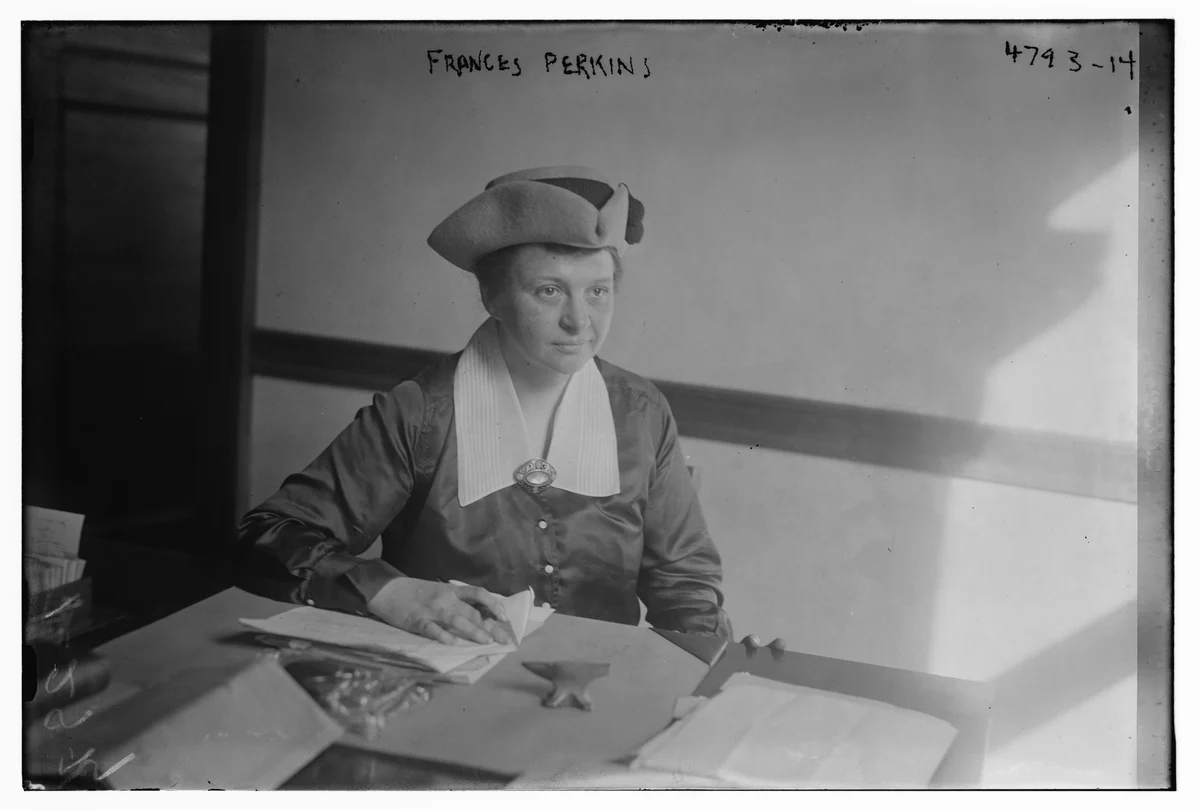
1880–1965
Frances Perkins
U.S. secretary of labor and social insurance reformerA social worker and labor administrator who brought years of workplace investigation into the New Deal, helping establish national protections against economic insecurity.Read biographyQuick answers
Common questions
- Was Frances Perkins the sole author of Social Security?
- No. She chaired the Committee on Economic Security and provided crucial leadership. Staff, advisers, other Cabinet officials, Roosevelt and Congress shaped the proposals and enacted law.
- What is the difference between old-age assistance and old-age insurance?
- In the 1935 framework, assistance supported state programs for needy older people. Federal old-age insurance connected future retirement benefits to covered employment and contributions. They were separate parts of the same Act.
- Why are 1935 and 1940 both associated with Social Security’s beginning?
- The Act became law on 14 August 1935. Contributions began in 1937. Following the 1939 amendments, recurring monthly benefits started in January 1940, earlier than the original 1942 schedule.
- Did the original law cover agricultural and domestic workers?
- Its old-age insurance provisions excluded agricultural labor and domestic service in private homes, along with other categories. These occupational exclusions affected many Black workers and were among the original system’s major limits.
Primary and institutional sources
How this history was checked
The executive order, committee report, 1935 statute and Perkins’s contemporary broadcast are read alongside institutional histories of coverage and implementation. These archival sources describe the original program and its early development. This article was reviewed on 21 October 2026.
- Social Security AdministrationExecutive Order 6757, 29 June 1934
- Committee on Economic Security, preserved by SSAReport of the Committee on Economic Security
- Social Security AdministrationThe Committee on Economic Security — structure and staff
- Frances Perkins, preserved by SSASocial Insurance for U.S. — radio address, 25 February 1935
- Social Security Board, preserved by SSASocial Security in America (1937) — preface
- U.S. Congress, preserved by SSASocial Security Act of 1935 — historical text
- Social Security AdministrationSocial Security Programs in the United States — Historical Development
- Social Security BulletinLarry DeWitt: The Decision to Exclude Agricultural and Domestic Workers from the 1935 Social Security Act
- Social Security AdministrationHistorical Background and Development of Social Security
- Social Security AdministrationThe First Social Security Beneficiary — Ida May Fuller