
The short answer
Which records support credit for a medical product’s development, and which claims require different evidence?
Original source comparison
Credit follows a contribution, not just a surname
Different records identify different roles in a development process.
| Record | What it supports | What remains unestablished |
|---|---|---|
| Company history | Named collaborators, prototype, manufacturing team and first sale. | Sole founder authorship, all patent claims or every clinical outcome. |
| Productivity Commission box | An institutional explanation of knowledge combination and specialist suppliers. | A complete development archive or clinical effectiveness review. |
| 2002 Paykel tribute | Company remembrance of executive backing for healthcare development. | Proof that Paykel personally designed every component. |
Chronology
A timeline of the turning points
Appliance enterprise
Four named founders form Fisher and Paykel.
Cross-institution development
Clinical, government-engineering and appliance expertise combine.
Prototype history
Company dates its healthcare origin to this year.
First company sale
The historical company account records a respiratory-humidifier sale.
Begin with the problem and the named participants
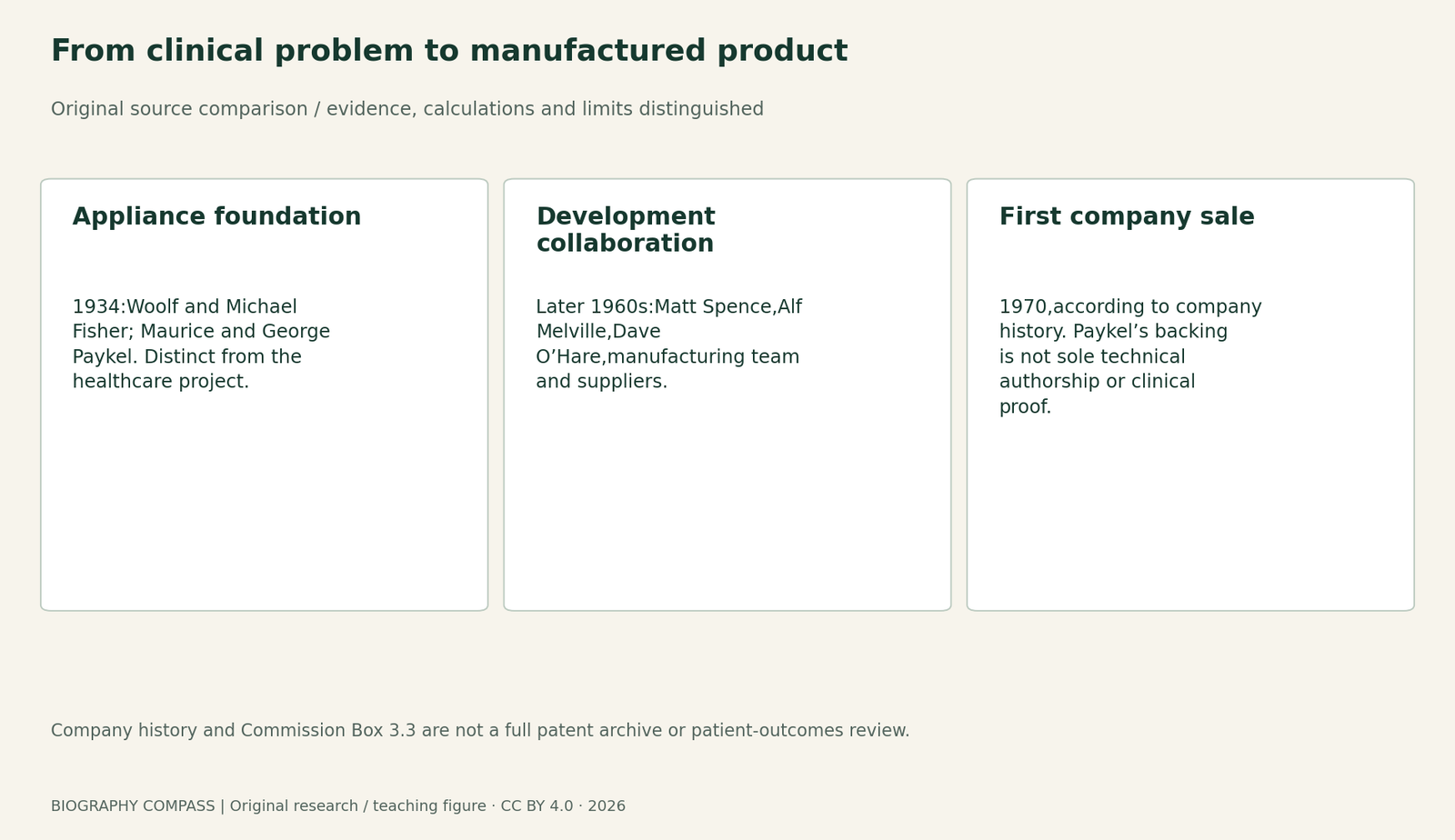
Fisher & Paykel Healthcare’s history begins its medical-business account in 1969. It names Auckland Hospital clinician Matt Spence, government electrical engineer Alf Melville and company engineer Dave O’Hare. The problem arose in respiratory care; a prototype incorporated a fruit-preserving jar. These details identify different contributions rather than a single moment when a founder supposedly invented an entire business. They also distinguish the origin of the healthcare work from the appliance enterprise established in 1934. A familiar corporate name should not replace the people and institutions named in the development record.
Prototype and manufactured product are different stages
The company describes a small team taking the prototype into manufactured form and dates its first respiratory-humidifier sale to 1970. That gives two useful milestones: development around 1969 and a first company sale in 1970. It does not supply exact day-to-day durations, production volumes or the date of every design improvement. A prototype can demonstrate an approach while leaving reliability, repeatable manufacture, specialist components and distribution unresolved. Treating the first working model as equivalent to a finished international product hides the work needed to cross those boundaries.
Sources for this section: [2]
Read a second institutional account for the mechanism
The Productivity Commission’s Box 3.3 uses the history as an example of combining knowledge across organisations. It describes a clinician, a government engineer, appliance expertise and specialist suppliers, then the company’s further development of the equipment. The box supports a collaborative explanation of industrial diversification. It is an economic-policy account, not a full clinical study or a complete laboratory notebook. Its purpose differs from the company’s retrospective history. Agreement on collaboration is useful, while neither text by itself proves every priority claim or evaluates every later product.
Keep executive backing distinct from technical authorship
Woolf Fisher and Maurice Paykel helped build the appliance company in which this work developed. The company’s 2002 tribute specifically credits Paykel with recognising the humidifier’s potential and supporting the work needed for a healthcare business. That is evidence of executive sponsorship in the company’s own account. It does not replace the named clinical and engineering contributions. A useful credit map can therefore include founders, project participants, production teams and institutional partners without treating their roles as identical. Each assertion should be attached to the record that actually supports it.
Original exercise: repair a fictional invention label
A fictional exhibition label states: “Woolf Fisher and Maurice Paykel personally invented the finished humidifier in 1934; the jar prototype proves that every later product improved patient outcomes.” Replace it with a four-part note covering the appliance-company foundation, the named development collaborators, the prototype-to-product work and the first company sale. Then classify three further claims as supported or requiring more evidence: Paykel provided backing; every design was solely his; a first sale demonstrates clinical effectiveness. Use only the inspected histories and the company tribute, and do not invent a patent, trial or production-volume record.
Reference answer: distribute credit and limit the inference
The appliance company’s foundation belongs to 1934 and includes the two founders’ fathers. The healthcare account belongs to the later 1960s and names Spence, Melville and O’Hare, followed by a manufacturing team. The company dates its first respiratory-humidifier sale to 1970. Its tribute supports the narrower claim that Paykel backed development. Sole design authorship is not established. A sale is a commercial event, not a substitute for clinical evidence about effectiveness or safety. The corrected label should preserve these roles and stages rather than turning a prototype into proof of every later claim.
Use the history without making a universal priority claim
The evidence supports a specific account of collaboration and the movement of appliance capabilities into another field. It does not require a claim that no earlier humidifier existed anywhere, or that company founders personally performed every experiment. The Commission box and company history were read within their stated scopes; the full clinical, patent and engineering archives were not reviewed. This leaves a meaningful historical conclusion: an enterprise’s ability to develop a product can depend on connecting clinical knowledge, engineering and manufacturing. Recognition becomes more precise when the record’s collaborators remain visible.
Continue the chronology
Related history guides
Did Laidlaw’s Catalogue Prove Availability?
Does listing a product establish that a customer could actually obtain it at the printed price?
Read the timeline1880s–1897Was a Workplace Benefit Freely Chosen?
Does an employer’s support for a benefit fund establish that joining it was free and voluntary?
Read the timelineBiography context
Explore New Zealand through connected lives
Connected biographies
Business lives in context
1912–1975
Woolf Fisher
Manufacturer, steel-industry chairman and educational benefactorWoolf Fisher helped develop an appliance manufacturer, chaired the formation of New Zealand Steel and founded a trust supporting teachers’ overseas study.Read biographyDied 2002
Maurice Paykel
Appliance manufacturer and health-research benefactorMaurice Paykel helped lead Fisher and Paykel’s move from importing into manufacturing and supported the company’s healthcare work and independent research philanthropy.Read biographyQuick answers
Common questions
- Does the 1934 company date establish the humidifier date?
- No. The healthcare work belongs to the later 1960s, with a first company sale recorded in 1970.
- Does a prototype or sale prove clinical effectiveness?
- No. Those records answer development and commercial questions; clinical claims need suitable patient evidence.
Primary and institutional sources
How this history was checked
Compare the stated source scopes. The original exercises and reference answers are teaching material; fictional records are labelled. No complete catalogue, inquiry, clinical archive or full economic report was read. This article was reviewed on 27 October 2026.
- Anna Nathan, Dictionary of New Zealand Biography / Te AraFisher, Woolf
- Fisher & Paykel HealthcareOur history: respiratory humidifier development
- New Zealand Productivity Commission; archived by TreasuryNew Zealand firms: Reaching for the frontier, Box 3.3
- Fisher & Paykel Healthcare; company text indexed by Manuals PlusFisher & Paykel Healthcare Annual Report 2002: Maurice Paykel tribute