
The short answer
Felix in Exile asks what happens to the memory of violence as a landscape changes. This guide places the 1994 animated film beside South Africa’s political transition, distinguishing the work’s formal choices from claims that its fictional figures document particular people.
Chronology
A timeline of the turning points
An earlier film
Johannesburg, 2nd Greatest City after Paris begins the film sequence listed in MoMA’s 1999 catalogue.
Felix in Exile
The film is made before the ANC’s election victory.
A maker’s account
Kentridge discusses drawing, characters and interpretation with Lilian Tone.
Museum interpretation
MoMA places Felix in Exile within an exhibition about contemporary art’s recurring themes.
Its election-year date is context, not a literal plot summary
MoMA’s 2005 account identifies Felix in Exile as a 1994 work made before the ANC’s election victory. That timing places it close to a moment of dramatic political expectation. It does not make the film a record of the election campaign, an inauguration film or a retrospective made after the transition was settled.
The Japan Art Association connects its disappearing bodies with concern that celebration might conceal earlier sacrifice. Political change and remembrance are therefore related questions, but not identical ones: a new constitutional order does not itself tell viewers how the past will be remembered.
The drawings retain a material past
Electronic Arts Intermix describes Kentridge’s animation as showing erasure and reworking. A changed mark leaves something behind. Movement can thus expose alteration rather than presenting a world whose previous state has vanished without a trace.
In the 1999 MoMA interview, the artist explains how drawings and films affect one another. Sheets remaining at the end are not a complete stack of separate finished frames. Reading the animation through this process helps explain why the drawing’s history matters alongside the story being projected.
A fictional perspective mediates the memory of violence
MoMA describes recollections of apartheid violence reaching the fictional Felix through a Black South African woman’s eyes. That mediation matters: the work stages a relation between looking, distance and knowledge rather than giving spectators an unfiltered historical camera.
A character’s drawn body should not be relabelled as a photograph of an identified victim. The distinction protects both the artwork’s imaginative operation and the factual standards needed when describing actual deaths.
Sources for this section: [5]
The setting does not supply a one-to-one political key
Kentridge’s discussion with Tone resists assigning every image to one political event. He also recognises connections between characters first conceived as opposites.
This cautions against an illustrated code, not against considering apartheid. Ask what the image makes uncertain rather than which real person each figure must represent.
Sources for this section: [3]
Different records answer different viewing questions
MoMA’s 1999 film list records a duration of eight minutes and forty-three seconds; its later press account uses a rounded eight-minute description. Those are compatible levels of precision, not evidence of different films.
The catalogue establishes format and chronology, the artist’s interview illuminates process, and later institutional discussion supplies an interpretation. None replaces viewing the complete work in an authorised presentation. This guide uses those selected records and does not reproduce the film, soundtrack or restricted artwork stills.
Biography context
Explore South Africa through connected lives
William Kentridge
Read across drawing, training, theatre and collaboration.
Explore the biographiesA different formThe Head & the Load
Compare a later collective stage work about historical absence.
Explore the biographiesDocumented historyThe Rivonia Trial
Keep an actual legal proceeding distinct from an artwork’s invented figures.
Explore the biographiesConnected biographies
The artist and the longer working life
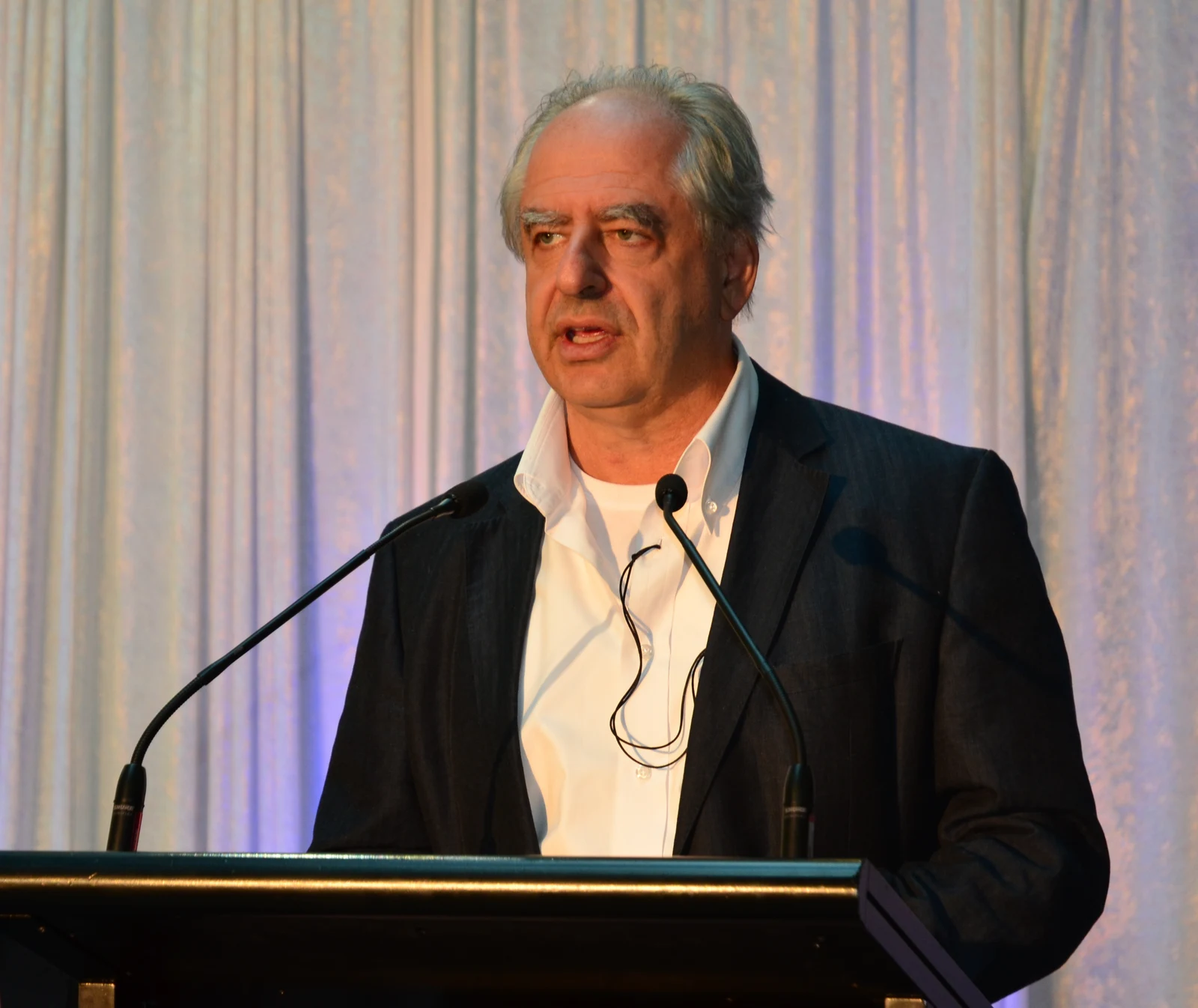
1955–
William Kentridge
Visual artist, filmmaker and theatre and opera directorWilliam Kentridge moves between drawings, projected images and live performance. His Johannesburg background informs work about apartheid, colonialism and memory, but an erased charcoal mark or an unresolved theatrical scene often complicates the story rather than delivering a single political message.Read biographyQuick answers
Common questions
- When was Felix in Exile made?
- 1994, before the ANC’s election victory, according to MoMA’s account.
- How long is it?
- The 1999 MoMA catalogue lists eight minutes and forty-three seconds; a later press account rounds this to eight minutes.
- Is Felix a real historical victim?
- MoMA identifies him as fictional. The film should not be substituted for documentary evidence about named people.
- Does every image have a fixed political meaning?
- The artist’s interview cautions against that kind of one-to-one interpretation while retaining the importance of South African history.
Primary and institutional sources
How this history was checked
Selected MoMA catalogue/interview and press-release passages, distributor biography and award-body commentary. Tate access returned403; no claim to have read that page or viewed the complete film. The contextual 2012 portrait does not depict the 1994 production. This article was reviewed on 24 October 2026.
- Electronic Arts IntermixBiography — education, theatre and animated drawing
- Japan Art Association2019 Praemium Imperiale — selected biography and Felix in Exile discussion
- MoMA / Lilian Tone and William KentridgeProjects 68, 1999 — selected interview passages and film list
- Peter Campbell / Wikimedia CommonsExact 2012 photograph — creator-uploaded original and CC BY-SA 3.0 grant
- The Museum of Modern Art26 August 2005 — selected Felix in Exile passage in Take Two announcement