
The short answer
What does a development plan’s first progress report actually prove? Use the government’s own categories to test claims about Michael Okpara’s programme and ask who could benefit.
Four distinct measures
Do not promote a budget into an outcome
Each measure answers a different question about implementation.
| Country | Measure | Question answered | Further evidence needed |
|---|---|---|---|
| Allocation | What provision was planned? | Six-year financial intention | Authorization and revision records |
| Actual spending | What was spent in the stated year? | Annual financial execution | Audited project accounts |
| Acres planted | What physical planting was recorded? | An intermediate output | Survival and maturity records |
| Household benefit | Whose income or security improved? | An impact question not settled here | Yields, access and household evidence |
Chronology
A timeline of the turning points
First reporting year
The main actual-spending period of the 1964 report.
Second-year estimates
The report includes estimates and selected updated achievements; their status must be checked by column.
First Progress Report published
Official Document No.15 of 1964, Government Printer, Enugu.
Plan horizon
Six-year allocation horizon, not a claim that this volume reports final outcomes.
Identify the volume and its reporting window
The National Library repository’s short title says Eastern Nigeria Development Plan 1962–68, but the scanned title page specifies First Progress Report, published in Enugu in 1964 by the Government Printer. The issuing ministry was regional Economic Planning. Its opening explains that it covers 1962–1963 with projections and selected information reaching into the second year. This is neither the original plan in every detail nor a final assessment of 1968. Naming the document accurately is the first substantive act of interpretation: otherwise a reader can mistake a revised expectation for a completed project or assign the report’s publication date to every figure it contains.
Sources for this section: [1]
Compare like periods before calculating performance
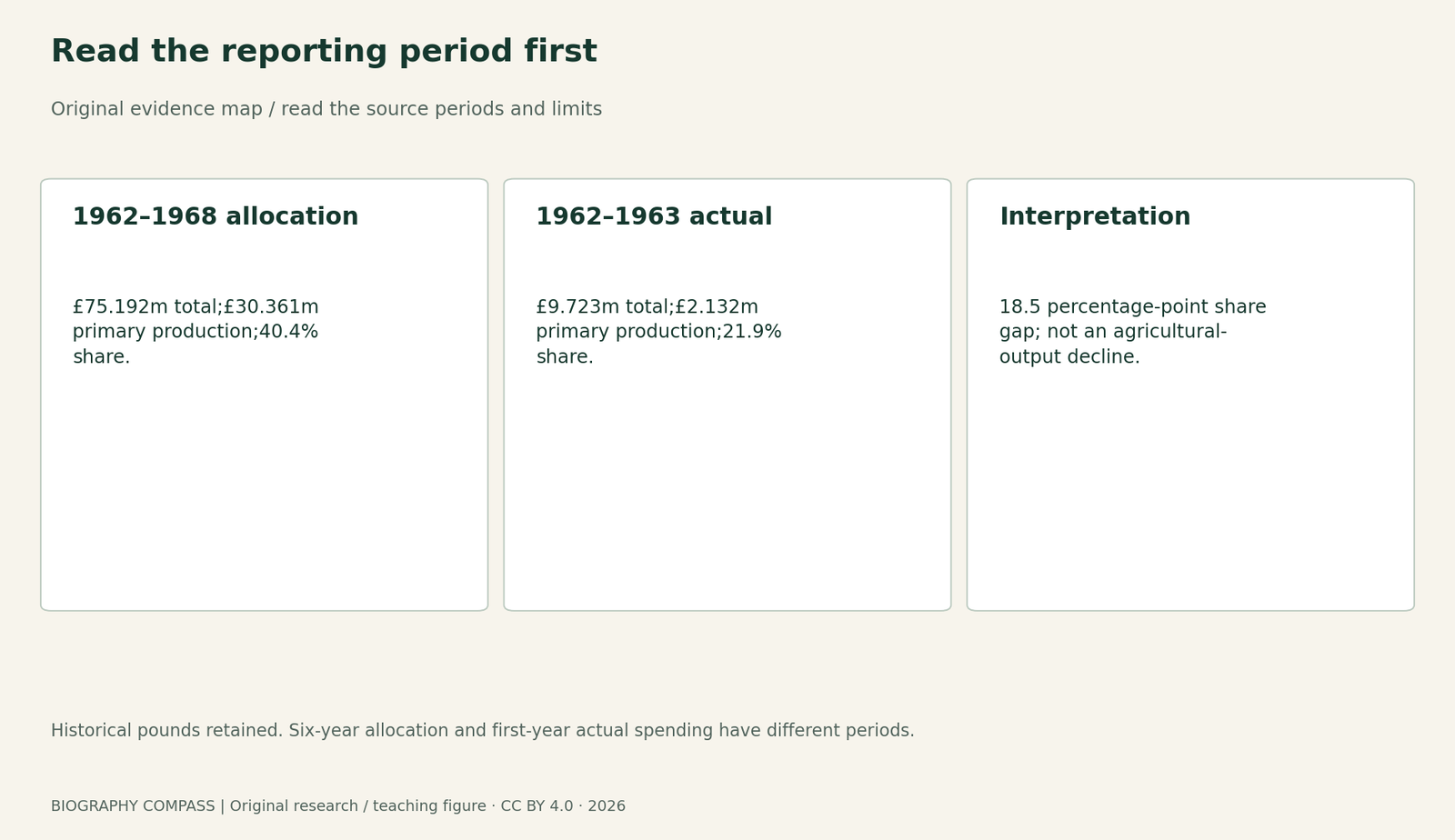
Table I on printed page 3 gives a 1962–1968 capital allocation of £75.192 million and actual 1962–1963 spending of £9.723 million. The third money column estimates £12.830 million for 1963–1964. They are six-year allocation, one-year actual and next-year estimate respectively. Comparing them can reveal scale and timing, but dividing the first-year actual by the six-year allocation does not establish that the government achieved only that fraction of an annual target. Keep the historical pounds unchanged. Converting to modern naira without a specified price basis would create another comparison problem rather than solve this one.
Sources for this section: [1]
Read priorities without equating money and benefit
Primary production carried £30.361 million of the six-year allocation and £2.132 million of first-year actual expenditure. Its planned share was 40.4%, while its first-year actual share was 21.9%. The report discusses the difficulty of mobilizing staff and implementation machinery, and the need to finish projects from an earlier programme. These are explanations offered by the administration, not independently proven excuses. They are nevertheless more specific than either praising every budget line or declaring every shortfall evidence of corruption. The report itself cautions that capital spending is an inadequate measure of physical achievement. A programme can spend money without producing durable benefits, or delay expenditure while preparing work.
Sources for this section: [1]
Treat revised acreage as a changed promise
Printed page 6 gives original tree-crop targets of 100,000 acres of oil palm, 150,000 of rubber and 75,000 of cocoa. It reports revised targets of 116,320, 107,720 and 46,640 respectively. These are revised intended acreages for the programme, not completed plantations. The explanation connects reductions to overambitious schemes and uncertainty about a cocoa nucleus plantation. It also stresses maintenance until trees mature. Therefore, counting newly planted acres cannot establish a harvest, income increase or sustainable livelihood. A useful follow-up would connect planting cohorts to survival, yields and producer returns over the years needed for the crops to mature.
Sources for this section: [1]
Separate the institutions doing the work
The report distinguishes ministry schemes, Eastern Nigeria Development Corporation plantations, university training and research, and a federal research unit at Umudike. Its discussion of extension workers shows how a training bottleneck could limit field supervision. Such detail resists a biography in which one leader personally performs every project. Okpara headed the regional government, but programme delivery depended on organizations with separate tasks and resources. Federal and regional activity also coexisted at a single location. An agency map is often a better research tool than a list of buildings because it reveals where responsibility, coordination or evidence of failure should be sought.
Sources for this section: [1]
Ask who could enter the programme
Korieh’s later historical research examines the unequal access to land, finance and settlement contracts, including arrangements favouring male holders. That question is different from how much government spent. Ekpo’s interview-based biography recounts her demand for women producers’ representation in the regional marketing system, illustrating a contemporary concern about whose voice counted. The sources do not establish that she wrote the plan or that one speech transformed its rules. Read them together to formulate a new investigation: do administrative totals distinguish women producers, tenants, households and contract holders, and which groups disappear when the unit of account is simply acres?
Exercise: label the columns before drawing a chart
Prepare a small evidence table with three rows: six-year total allocation £75.192 million; first-year total actual £9.723 million; and first-year primary-production actual £2.132 million. Label each as allocation or actual and attach its period. Calculate primary production’s share of first-year actual spending and the difference between that share and its planned 40.4% allocation share. Then write two possible explanations for the gap as research hypotheses, followed by one record that would test each. Finally decide whether the data justify a chart entitled Agricultural Output under Okpara. This original exercise requires a calculation and a decision about what the calculation means.
Sources for this section: [1]
Reference answer: distinguish a gap from its cause
The first row is a 1962–1968 allocation; the other rows are 1962–1963 actuals. Dividing 2.132 by 9.723 gives about 21.9%, approximately 18.5 percentage points below 40.4%. This is a difference in expenditure composition, not an 18.5% fall in agricultural output. Possible hypotheses include administrative delays or earlier projects absorbing funds; dated implementation returns and project-level expenditure ledgers could test them. The proposed output title is unsupported because the figures concern spending. Use a title such as Planned and First-Year Spending Shares and retain the different periods. A later impact assessment would also need production, distribution and household evidence.
Sources for this section: [1]
Continue the chronology
Related history guides
Biography context
Explore Nigeria through connected lives
Connected biographies
Lives connected with the documents
1920–1984
Michael Okpara
Medical practitioner and premier of Nigeria’s Eastern RegionMichael Iheonukara Okpara led Nigeria’s Eastern Region from 1959 until military rule in 1966. His government pursued agricultural and industrial development whose ambitions and early difficulties appear in its own progress report.Read biography1914–2006
Margaret Ekpo
Women’s organizer, NCNC politician and Eastern regional legislatorMargaret Ekpo linked women’s livelihoods with anti-colonial organization and elected politics. A teacher and businesswoman, she built a constituency in Aba and entered the Eastern Regional House of Assembly in 1961.Read biography1912–1966
Abubakar Tafawa Balewa
Nigeria’s first prime ministerAbubakar Tafawa Balewa became prime minister in 1957 and continued after independence in 1960. His diplomacy combined African cooperation with Commonwealth ties; his government ended in the January 1966 coup.Read biographyQuick answers
Common questions
- Is the 1964 document the original development plan?
- It is the First Progress Report on the 1962–1968 plan. Its title page and introduction establish that scope.
- Does the spending gap prove a fall in farm production?
- No. It compares financial shares across different planning periods; production and welfare require different data.
Primary and institutional sources
How this history was checked
Read the original record, identify the claim it can establish, and keep interpretation separate from verified outcome. This article was reviewed on 27 October 2026.
- Eastern Nigeria Ministry of Economic Planning; Government Printer, EnuguEastern Nigeria Development Plan 1962–68: First Progress Report, Official Document No.15 of 1964
- University of Calgary PressThe Land Has Changed, chapter 6: The African Elite, Agrarian Revolution, and Sociopolitical Change, 1954–80, Chima J. Korieh
- Africa Leadership Forum / ALF Publications; National Library of Nigeria digital repositoryMargaret Ekpo: Lioness in Nigerian Politics, Stella A. Effah-Attoe and Solomon Odini Jaja, 1993