
The short answer
Migrant Mother is both an influential photograph and the record of an encounter whose participants did not tell the same story. Reading the surviving frames, captions and later accounts together reveals more than an anonymous symbol of hardship. It restores Florence Owens Thompson’s name and agency while making Dorothea Lange’s photographic choices visible.
Chronology
A timeline of the turning points
A federal photographic assignment
Lange joined the Resettlement Administration’s photography program after fieldwork with economist Paul Taylor.
The Nipomo encounter
Photographed Thompson and her children at a California pea pickers’ camp while documenting migratory agricultural labor.
Publication and public response
The family’s image circulated in newspaper coverage and became associated with relief for struggling farmworkers.
Lange’s published recollection
Popular Photography printed her later account of approaching the mother, photographing the family and hearing about their hardship.
Thompson’s identity and account
Thompson publicly identified herself; later family accounts challenged elements of the familiar narrative.
Another surviving view
OMCA identified a seventh image, preserved as a contact print from a negative presumed lost.
A relief assignment in agricultural California
Lange made the photographs at Nipomo in March 1936 while working for the Resettlement Administration. The assignment concerned migratory farm labor, rather than a commission for a timeless portrait of motherhood. The Farm Security Administration name belongs to a later stage of the photographic program; the familiar FSA/OWI archive title should not erase that institutional chronology.
This context directs attention beyond a single face. Lange’s broader fieldwork recorded labor, inadequate shelter and access to food and water. Her collaboration with Paul Taylor connected observation with research into the conditions facing agricultural workers. Such photographs could support arguments for assistance, but the purposes of an assignment did not automatically make every caption a complete account of the people depicted.
A pea pickers’ camp is a setting, not a whole identity
The surviving 1936 captions describe a thirty-two-year-old mother of seven children amid destitution at a pea pickers’ camp. One caption connects the camp’s distress with failure of the early pea crop. These records identify the agency’s framing of the scene. They do not establish that every person visible belonged permanently to that camp, had picked its peas or shared one identical migration history.
Later accounts identify the mother as Florence Owens Thompson. She was of Native American heritage, a fact obscured when viewers assumed the image represented white motherhood. Naming her changes the questions a viewer asks. Instead of letting an emblem supply a biography, it becomes possible to distinguish the camp’s circumstances from this particular family’s movements, work and memories.
Three layers of testimony
A useful reading separates the captions preserved with the 1936 photographs, Lange’s published recollection in 1960 and the later accounts of Thompson and her children. They are related evidence, not interchangeable transcripts. The Library of Congress notes that extended captions and supplementary textual files for the series have not been found. Gaps in that record cannot be filled by treating a later memory as contemporary field notes.
Lange recalled that the family had sold car tires for food. Thompson’s later account, summarized by OMCA, instead describes a breakdown and repairs before the family was ready to leave. Keeping the disagreement visible allows readers to assess its significance without inventing certainty about every exchange. The discrepancy also makes the sitter’s perspective part of the photograph’s history.
The series reveals photographic decisions
The best-known composition brings Thompson and three children into a tightly organized view. Other exposures show different distances and arrangements. Comparing them makes selection and framing visible: a photograph can bear witness to an encounter while still being made through decisions about where to stand, when to expose the film and which view to circulate.
Lange’s later description of five exposures should not be taken as the definitive number of surviving images. OMCA records a seventh view found in its archive in the early 2000s, a contact print from a negative presumed lost. The Library of Congress also warns that negative numbers were assigned later and cannot establish exposure order. A confident numbered reconstruction therefore requires evidence beyond those numbers.
Full frames, retouched negatives and unretouched prints
The image exists in materially different versions. The LOC guide identifies a retouched negative version and an unretouched print, LC-DIG-ppmsca-12883, in which a thumb appears in the foreground at right. A full scan of an archival negative can preserve that negative faithfully while still showing historic retouching. The word original in a download label therefore does not guarantee an image untouched since the camera exposure.
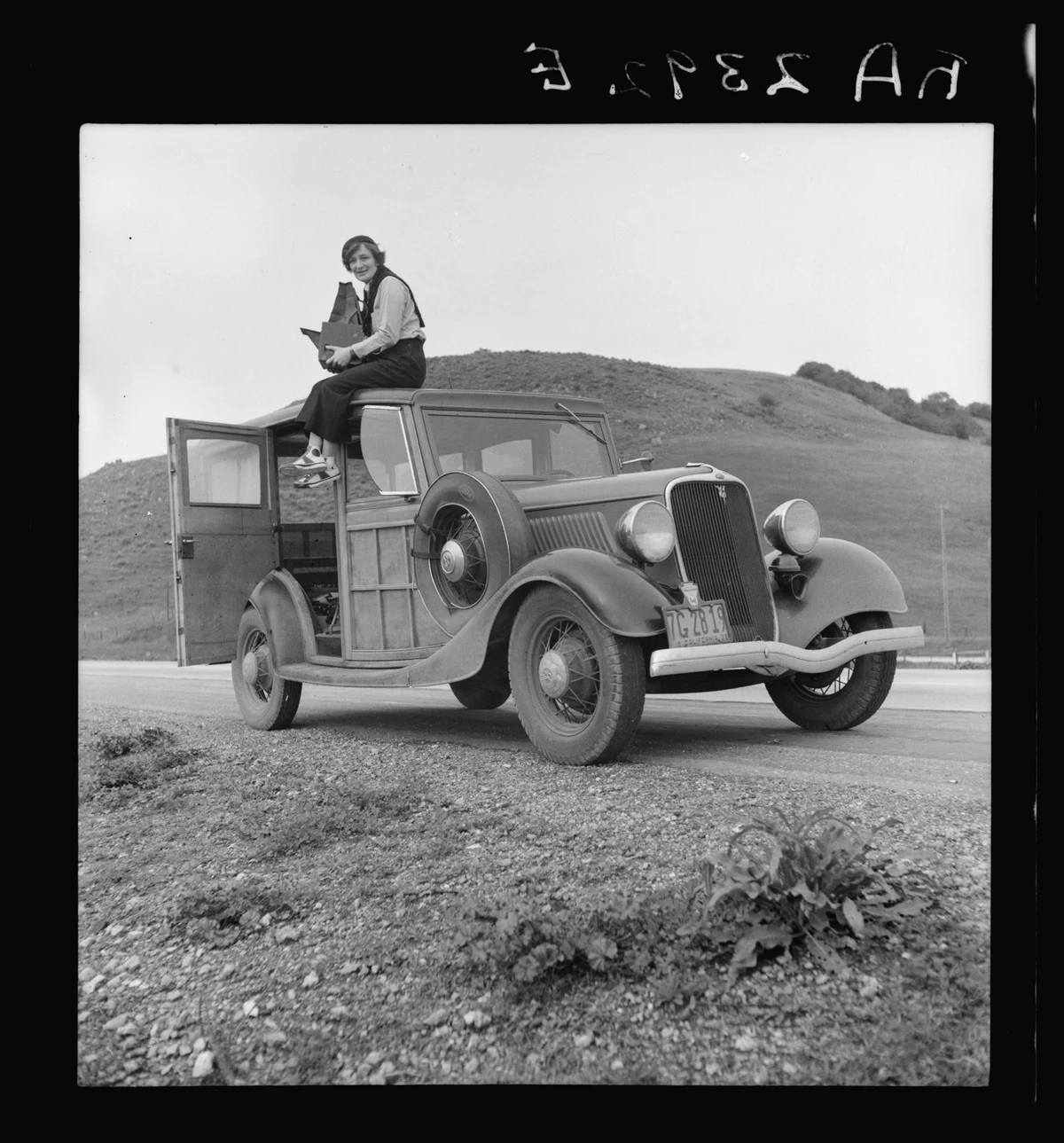
Readers comparing reproductions should check the exact catalog identifier, whether the file comes from a print or negative, and how much of its frame survives. A modern crop or restoration adds another layer. This guide uses a contextual portrait of Lange herself, explicitly dated February 1936, rather than silently presenting a restored Migrant Mother derivative as the camera’s unaltered record.
Influence and the people within the picture
Newspaper circulation made the photograph part of a public response to farmworker hardship. Its effectiveness as a symbol, however, did not give Thompson control over how others understood her life. OMCA recounts the distress the image caused her family and the children’s later, more complex assessment of its power to help others. Public influence and a sitter’s experience need to be considered together.
The photograph remains valuable evidence when read with those limits. It records people negotiating an encounter, and it shows how an agency, a photographer, publishers and later audiences helped produce historical meaning. Looking across versions and listening to the family does not diminish close attention to Lange’s work. It makes that attention more exact, restoring persons and choices to a picture often encountered as an instantly recognizable icon.
Biography context
Explore United States through connected lives
Dorothea Lange beyond one photograph
Follow her portrait training, government fieldwork, wartime documentation and later projects.
Explore the biographiesExplore photography’s wider contextGeorge Eastman and photographic production
Consider the development of photographic materials and industry as background to a later documentary practice; no personal collaboration is implied.
Explore the biographiesConnected biographies
Explore photographic practice and its wider history
1895–1965
Dorothea Lange
Documentary and portrait photographerA photographer who combined portraiture, observation and written context to document labor, displacement and the effects of public policy on individual lives.Read biography
1854–1932
George Eastman
Photography entrepreneur, Kodak founder and philanthropistAn American entrepreneur who connected photographic manufacturing, roll-film cameras, processing services and advertising, while building the business later named Eastman Kodak.Read biographyQuick answers
Common questions
- When and for which agency was Migrant Mother made?
- Lange photographed Thompson’s family at Nipomo, California, in March 1936 while working for the Resettlement Administration. The photographic program later became part of the Farm Security Administration.
- Who was the woman, and why does her name matter?
- She was Florence Owens Thompson, a woman of Native American heritage. Her identity and the family’s later account prevent the photograph’s symbolic role from being mistaken for a complete description of her life.
- Does an original negative scan show the unretouched photograph?
- Not necessarily. The LOC guide distinguishes a retouched negative version from the unretouched print LC-DIG-ppmsca-12883, which shows a foreground thumb. A faithful scan can preserve historic retouching already present in its source.
- Should Lange’s tire story be stated as settled fact?
- No. Her 1960 recollection describes tires sold for food. Thompson’s later account describes car trouble and repairs. The two accounts should be attributed and distinguished, rather than combined into a single unquestioned narrative.
Primary and institutional sources
How this history was checked
The sources distinguish agency-era captions, Lange’s later recollection, the family account and materially different prints and negatives. The opening photograph depicts Lange in February 1936, not Thompson at the March Nipomo sitting. This article was reviewed on 21 October 2026.
- Library of CongressMigrant Workers — Documenting America
- Library of CongressDorothea Lange’s Migrant Mother photographs — introduction and 1960 recollection
- Library of CongressMigrant Mother series — captions, surviving views and thumb retouching
- Oakland Museum of CaliforniaDorothea Lange Teacher Resources — Facts about Migrant Mother, p. 13
- Oakland Museum of CaliforniaSeventh Migrant Mother image — A67.137.96897
- California State Capitol MuseumThe Dust Bowl, California, and the Politics of Hard Times
- The Museum of Modern ArtDorothea Lange — 1966 exhibition catalogue, chronology
- National Gallery of ArtDorothea Lange’s Innovative Approach to Portraiture — exhibition background
- Oakland Museum of CaliforniaAbout Dorothea Lange and her archive
- Library of CongressMigrant Mother print record — 2004681697, version with thumb retouched out
- Library of CongressDorothea Lange, Resettlement Administration photographer — contextual portrait, 2017759800
- Library of CongressFSA/OWI black-and-white photographs — complete rights advisory