
The short answer
Use the five linked Disney guides to practice making a historical claim and showing its evidence. Start with eight foundation questions, then compare the technical records for The Old Mill and Fantasia in questions 9–14. This original activity supports independent study and discussion; it is not an official Disney resource or a certified curriculum.
Chronology
A timeline of the turning points
Prepare your evidence
Use the first three readings for questions 1–8, then The Old Mill and Fantasia for questions 9–14. Note each external source’s author, purpose and relevant heading.
Answer before using the key
Record a source, its relevant section and the limit of its support beside each answer.
Check claims and revise
Compare your work with the guidance. Improve unsupported sentences rather than trying to match the wording.
Questions 1–2: distinguish chronology and responsibility
1. Using the Mickey source-comparison guide, put Plane Crazy, The Gallopin’ Gaucho and Steamboat Willie in production order. Explain why this does not, by itself, supply their complete theatrical-release order. Give the source passage you used.
2. In the Snow White credits, identify the producer and supervising director. Explain what additional evidence you would need to attribute a particular scene. Keep a named job distinct from an assumption about every task its holder performed.
Questions 3–4: follow contributors and compare source types
3. Identify the two performers discussed in the Snow White guide. Label the work each supplied, then explain how an animator could use one of those contributions without making the contributor an animator.
4. Compare Walt’s circa-1956 recollection of Roy with a production credit. What question is the recollection useful for? What would it fail to establish about a particular payment, contract or drawing? Give one example of a stronger record for that narrower question.
Questions 5–6: test the scope of a claim
5. Compare the sound milestone described by the Copyright Office with the broader wording discussed in the Mickey guide. Write a sentence you can defend from those readings. State what extra research would be needed before claiming priority across all animated films.
6. Find a named contribution by Hazel Sewell. Explain how that evidence changes a summary that mentions only the studio’s founders. Identify which museum account supplies the detail, and distinguish visual decision-making from the physical preparation of cels.
Questions 7–8: assess an image and build an argument
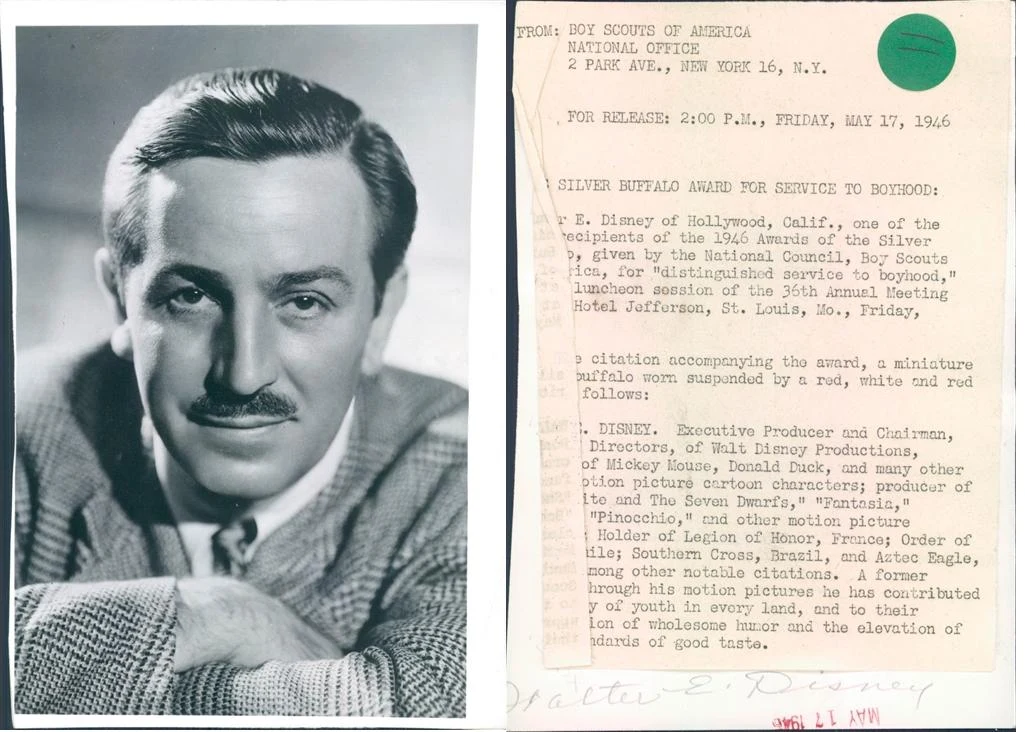
7. Read the date and description of this guide’s photograph. Could it establish who worked on a 1937 scene? Explain the difference between an image used to identify a person and an image documenting a particular event.
8. Write a short argument about how cooperation shaped early Disney animation. Use two contributors with different responsibilities and two specific source references. Include one limitation, such as incomplete staff records or a retrospective account. Avoid attributing every achievement to a founder or treating a credit as a complete work log.
Questions 9–10: compare technical functions and dated records
9. Compare the opening explanation of Garity’s Control Device for Animation with the Dubbing section of the 1941 Fantasound paper. What elements does each system coordinate? Explain one useful similarity and one difference. State what these descriptions leave unproven about a particular shot or screening.
10. Read the control-device patent’s inventor, assignee, application and grant information. Put those dates beside The Old Mill’s 1937 release. Which person and company does the record identify, and why should a patent milestone not be substituted for the construction date of every camera component?
Questions 11–12: separate counts, categories and recipients
11. Compare Scoring in the 1941 system paper with the Philadelphia recording setup described before Equipment Problems in the 1942 roadshow paper. What recording-channel count does each report? Then use Dubbing to distinguish program tracks from the control track. Explain why the two recording counts should not be presented as playback-channel counts.
12. Use the Academy’s records to compare the multiplane camera’s technical award with Fantasia’s sound-related special award. Identify each category, recipient and presentation year. Keep Stokowski’s separate recognition distinct. What can an award citation establish, and what would require more detailed production evidence?
Sources for this section: [13] · [14] · [16] · [17] · [18] · [19]
Questions 13–14: evaluate participants and build a comparison
13. Compare the opening purpose and equipment discussion in Garity and Jones’s roadshow paper with Plumb’s opening constraints and closing planning argument in The Future of Fantasound. Give one question each paper helps answer. Explain how the authors’ participation is useful and why it does not make either paper an independent audience study.
14. Write an 80–120 word argument connecting image-making in The Old Mill with sound presentation in Fantasia. Use the control-device patent and Plumb’s artistic appraisal, name two contributors, and distinguish a supported finding from your interpretation. End with one question that these two records cannot settle. Cite the relevant passages.
Sample answers 1–4: check the evidence behind your wording
1. The production sequence is Plane Crazy, The Gallopin’ Gaucho, then Steamboat Willie. Completion, preview and commercial release are different milestones. Evidence pointers: D23’s two film entries; Plane Crazy’s sound release came in 1929, despite being the first produced.
2. Walt Disney was producer; David Hand was supervising director. A particular scene would require more specific production records or reliable scene-attribution research. Evidence pointer: AFI’s production-credit headings.
3. Caselotti supplied the voice; Belcher supplied movement reference. Interpreting a performed action in drawings is a further contribution. Evidence pointers: the D23 performer profiles linked in the production-team guide.
4. Walt’s recollection supports an account of how he remembered the partnership and its tensions. A dated contract or payment record would be stronger evidence for a particular obligation or transaction. Evidence pointer: the museum’s interview transcript, with its approximate recording date.
Sample answers 5–8: allow conclusions of different strength
5. A defensible sentence is: “Steamboat Willie brought sound to the early Mickey-and-Minnie films.” Priority across all animation requires investigating earlier experiments. Evidence pointer: the Copyright Office’s specifically bounded description, compared with the other essays.
6. Sewell’s views on color appear in production notes described by the museum. The department’s work also carried drawings onto painted cels. Evidence pointers: the Hazel Sewell profile and the separate Ink and Paint article. These support different parts of the answer.
7. No. The retained publicity print has a 1946 release date. It supplies later portrait context, not a record of work on a 1937 scene. Evidence pointer: the original print’s reverse and the linked image record. A publication date is not necessarily the camera date.
8. Several arguments can earn full credit. A response might connect direction with a performer’s reference work, then explain how the source supports each role. Credit the quality of the evidence and the stated limitation, rather than the number of famous names or agreement with a single model paragraph.
Sample answers 9–10: explain the mechanism and the date’s meaning
9. The patent concerns positioning separate pictorial elements and coordinating their photography. The sound paper describes mixing into separate program tracks and a tone track. Both organize multiple inputs for a controlled result, but they handle different materials and operations. These descriptions explain intended functions; they do not reconstruct an individual shot or every theater presentation. Evidence pointers: the patent’s opening specification and Fantasound’s Dubbing section.
10. The patent names William E. Garity as inventor and Walt Disney Productions as assignee. It records application on 16 November 1938 and grant on 23 April 1940, after the film’s release year. Those are patent milestones. Establishing when a particular component was built or used requires other records. Evidence pointer: the original specification’s heading, rather than an assumption that invention, filing and use share one date.
Sample answers 11–12: retain discrepancies and formal award wording
11. The 1941 paper reports eight recording channels used; the 1942 paper describes nine installed. Preserve those attributed descriptions without inventing a reconciliation. The mixed sound print carried three program tracks and a tone-control track. Recording capacity, the mix and the playback arrangement answer different questions. Evidence pointers: Scoring and Dubbing in the first paper; the Philadelphia installation paragraphs in the roadshow account.
12. The camera’s Class II scientific or technical plaque names Walt Disney Productions, Ltd.; the presentation belongs to 1938. The sound-related special award, presented in 1942, names Walt Disney, William Garity, John N. A. Hawkins and RCA Manufacturing Company. Stokowski and his associates received separate recognition for visualized music. These citations identify formal recognition, not a complete crew or each person’s daily tasks. Evidence pointers: the named database entries and the two ceremony pages.
Sources for this section: [13] · [14] · [16] · [17] · [18] · [19]
Sample answers 13–14: separate appraisal from an evidence-based inference
13. Garity and Jones help answer how equipment was installed and operated. Plumb helps examine the relationship between musical aims, recording choices and dramatic use. Their participation gives access to practical experience and intentions, but also an interest in the work. Neither paper measures the response of every audience. Evidence pointers: the roadshow paper’s stated purpose and equipment discussion; Plumb’s production constraints and final planning argument.
14. One supported model is: “Garity’s later control-device patent describes coordinating separate pictorial elements. Plumb’s 1942 appraisal argues that recording and dramatic planning should work together. Read alongside The Old Mill and Fantasia, the records suggest that technical coordination and artistic decisions both mattered. That comparison is an interpretation based on different kinds of evidence. The patent is not a camera log for every earlier shot, and Plumb’s appraisal cannot establish how every theater audience responded. A remaining question is how a particular screening implemented the intended sound design.” Other well-cited comparisons can earn full credit.
A simple self-review rubric
For each response, check three things: the claim answers the question; the cited passage actually supports it; the wording stays within that passage’s limits. Award one point for each: up to 24 points for the eight foundation questions and 18 for the six technical comparisons, or 42 overall. Supported alternative arguments are acceptable. This is a suggested discussion rubric, not a validated assessment instrument.
Use the learner sheet below to write or print all 14 questions without the sample answers. No film subscription, full-film viewing or historical equipment is required. Follow the named source headings to challenge or improve an answer, and identify the passage precisely. Keep a patent’s intended operation distinct from evidence of its use, and a participant’s appraisal distinct from a measured audience response.
Continue the chronology
Related history guides
Walt and Roy Disney: Building the Studio
Follow the contracts, financing and distribution behind the studio’s growth.
Read the timeline1928Who Created Mickey Mouse?
Compare the evidence for creative credit, production order and the sound breakthrough.
Read the timeline1937Snow White: Artists and Collaboration
Distinguish direction, voices, movement reference, animation and ink-and-paint work.
Read the timeline1937 · Film and equipmentThe Old Mill and the Multiplane Camera
Compare depth photography, named production roles, patent records and two separate awards.
Read the timeline1940 · Music and engineeringFantasia and Fantasound
Compare recording, theater playback, engineering roles and the evidence for different awards.
Read the timelineBiography context
Explore United States through connected lives
Connected biographies
Biographies for further reading
1901–1966
Walt Disney
Animation producer and entertainment entrepreneurWalt Disney was an American animation producer and entrepreneur who built an entertainment business with his brother Roy. His work ranged from silent cartoon production to Mickey Mouse, animated features, television and Disneyland, with essential contributions from artists, performers and business partners.Read biography
1893–1971
Roy O. Disney
Studio cofounder, business executive and financierRoy O. Disney was the business partner and older brother of Walt Disney. He helped sustain the studio’s growth, develop distribution and licensing, and carry the Florida resort project through to its 1971 opening after Walt’s death.Read biographyQuick answers
Common questions
- Do I need to watch the films to complete the activity?
- No. The questions concern evidence in the linked readings and source descriptions. They do not test unprovided film scenes.
- Are the sample answers the only acceptable responses?
- No. A different interpretation can be well supported. Explain the evidence and its limits, especially for the final argument.
- Is the learner sheet an official Disney worksheet?
- No. Biography Compass wrote these questions independently. No Disney affiliation, endorsement or curriculum certification is claimed.
- What do the technical comparison questions cover?
- Questions 9–14 compare image coordination, sound tracks, patent dates, formal awards, participant perspectives and the limits of the records.
- How is the expanded worksheet scored?
- The suggested rubric gives up to 24 points for questions 1–8 and 18 for questions 9–14: 42 overall. It rewards a relevant claim, supporting evidence and an appropriate limit.
Primary and institutional sources
How this history was checked
Questions, answer guidance and the rubric were written for Biography Compass, not copied from museum teaching materials. The extension compares a patent specification, period engineering papers, a musician’s appraisal and formal award records. The papers are read through identified transcriptions; later curator comments are separate from the authors’ text. Source pointers name the passages to inspect. Original questions 1–8 remain intact. The unchanged portrait supplies context rather than evidence of a production event; no full-film viewing, historical-equipment test or studio-ledger inspection is assumed. This article was reviewed on 25 October 2026.
- Dave Smith / National Film Preservation Board, Library of CongressSteamboat Willie: essay by Disney’s chief archivist emeritus
- D23 / Disney A to ZPlane Crazy: first produced, later sound release
- D23 / Disney A to ZThe Gallopin’ Gaucho: second produced, later sound release
- American Film InstituteSnow White and the Seven Dwarfs (1937): credits and historical notes
- D23 / Disney LegendsAdriana Caselotti: voice performer
- Beth Deitchman / D23Remembering Marge Champion (2020)
- The Walt Disney Family MuseumIn Walt’s Own Words: His Brother Roy — circa-1956 interview transcript
- U.S. Copyright Office / Library of CongressLifecycle of Copyright: 1928 Works in the Public Domain (2024)
- Brenda Litzinger / The Walt Disney Family MuseumImportant Women in Disney History: Hazel Sewell
- The Walt Disney Family MuseumLook Closer: Women in the Disney Ink and Paint Department
- Boy Scouts of America / Wikimedia CommonsWalt Disney publicity print: complete archived front and reverse, released 17 May 1946
- U.S. Patent Office / Google PatentsWilliam E. Garity, Control Device for Animation, 2,198,006: original specification at PDF p. 11
- William E. Garity and J. N. A. Hawkins / Journal of the Society of Motion Picture EngineersFantasound, August 1941: period paper transcribed by the American Widescreen Museum
- William E. Garity and Watson Jones / Journal of the Society of Motion Picture EngineersExperiences in Road-Showing Walt Disney’s Fantasia, July 1942: transcription
- Edward H. Plumb / Journal of the Society of Motion Picture EngineersThe Future of Fantasound, July 1942: participant’s artistic appraisal, transcribed
- Academy Awards DatabaseWalt Disney Productions, Ltd.: 1937 (10th) Scientific or Technical Award, Class II
- Academy Awards Database1941 (14th) Special Awards: the sound collaborators and Stokowski’s associates
- Academy of Motion Picture Arts and SciencesThe 10th Academy Awards: 1938 ceremony and cartoon award
- Academy of Motion Picture Arts and SciencesThe 14th Academy Awards: 26 February 1942 ceremony