
The short answer
Why can two stories involving Irish business leaders and foreign courts describe fundamentally different debts? Start with the named debtor, then follow the legal question each record actually decides.
Original source comparison
What question does each record decide?
Read the named subject and operative question before comparing the outcome.
| Country | Supported observation | Limit |
|---|---|---|
| Bermuda sanction order | Named companies and creditors receive scheme sanction. | No personal bankruptcy adjudication of O’Brien. |
| Issuer closing release | Corporate debt changes and board reconstitution are announced. | Expected savings are not personal cash proceeds or later outcomes. |
| O’Reilly recognition opinion | The individual proceeding fails the motion’s main/nonmain tests. | No cancellation of the Bahamian bankruptcy or ruling on every creditor claim. |
Chronology
A timeline of the turning points
Individual proceeding
O’Reilly’s Bahamian bankruptcy filing, as recorded by the US opinion.
US recognition decision
Main recognition denied with prejudice; nonmain request denied without prejudice.
Bermuda scheme sanction
Court sanctions the specified corporate scheme.
Former-parent transaction
DGHL transaction closes, according to the later issuer release.
Corporate completion
Digicel announces closing and a reconstituted board.
Begin with the named debtor
A business founder, a corporate group and a company inside that group are different subjects. Digicel’s January 2024 announcement concerns financial restructuring across specified companies. Tony O’Reilly’s 2019 US case names an individual debtor and a foreign representative seeking recognition of a Bahamian proceeding. The useful comparison is not which businessman had the larger headline fortune. It is whose obligations were being addressed, which court was acting and what outcome the record establishes. A short research note should begin with those three fields. Without them, “bankruptcy” becomes a vague description that conceals more than it explains.
The corporate scheme had named parties and stages
The Bermuda Supreme Court’s sanction order of 6 November 2023 identifies Digicel International Finance Limited and Digicel Intermediate Holdings Limited as petitioners. It records creditor meetings on 18 October and sanctions the specified scheme. The order’s function is narrower than a biography: it establishes a legal stage concerning those companies and creditors. It does not adjudicate a personal bankruptcy of Denis O’Brien. Nor should sanction automatically be treated as the commercial completion date. The January issuer release supplies the later closing event. Recording both dates explains how legal approval can precede the implementation of a wider transaction.
One group headline covers connected transactions
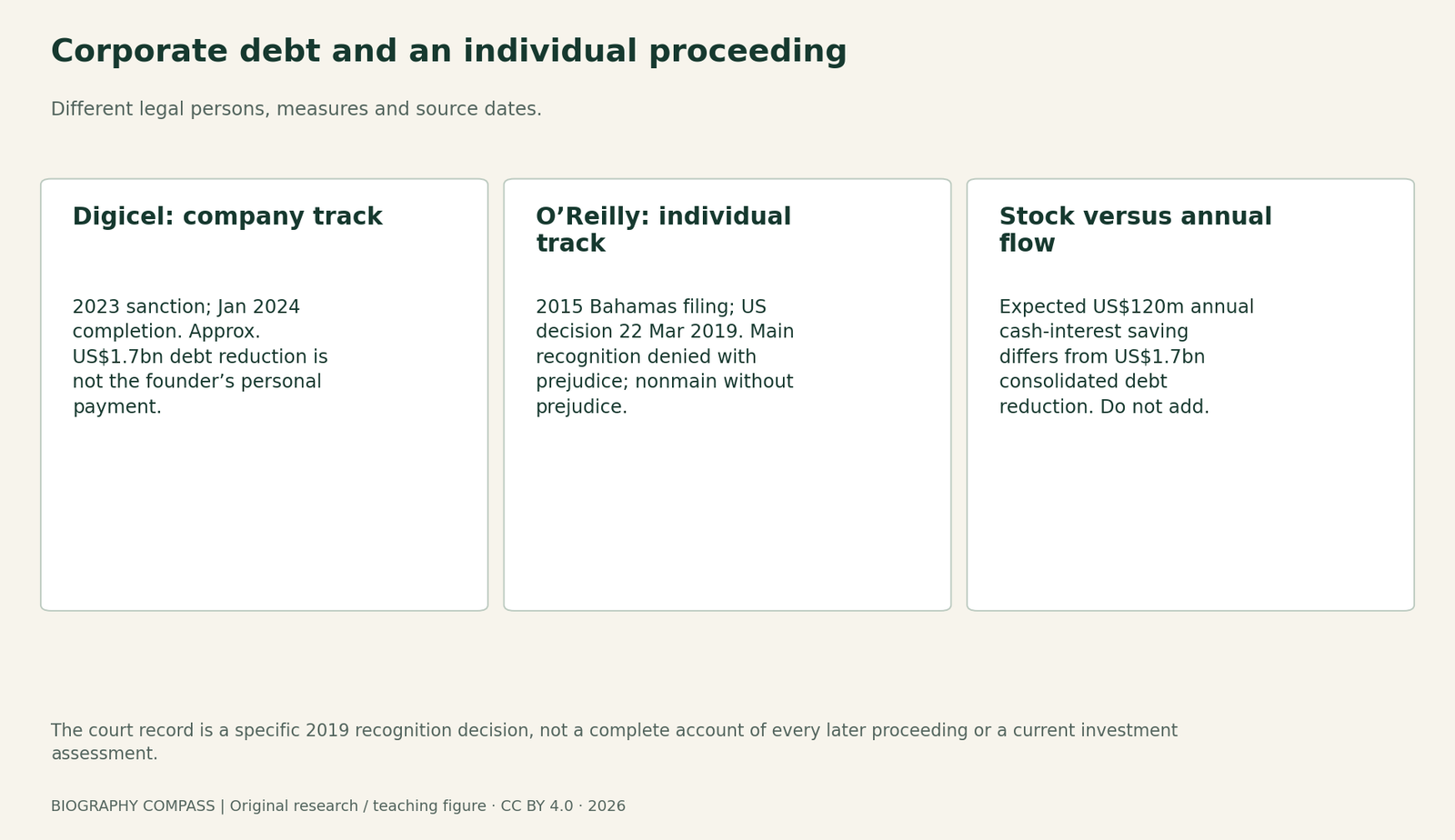
Digicel’s 29 January 2024 release distinguishes that transaction from its former parent DGHL’s restructuring, completed on 14 November 2023. It says the connected changes reduced consolidated debt by approximately US$1.7 billion. It also anticipates around US$120 million less annual cash interest. One is a reduction in a stock of obligations; the other is an expected recurring expense effect. They should not be added into a supposed pot of cash. The release describes some notes becoming equity and other debt being extended. That mix explains why “the company paid off every creditor” would be an inaccurate paraphrase.
Sources for this section: [1]
A founder’s control can change without personal adjudication
The same announcement names a reconstituted board, with Rajeev Suri as chairman and O’Brien continuing as a director and equity holder. Independent reporting describes former bondholders taking control. This is a significant business setback for a founder who previously controlled the enterprise, even though customers could continue using its networks. It does not make the founder the petitioner in every corporate proceeding. O’Brien’s biography should record the loss of control and dated change of title. The legal comparison should remain anchored to the documents, rather than using his continuing public prominence as evidence that no financing problem occurred.
O’Reilly’s case concerned an individual and cross-border effect
The official Pennsylvania opinion records O’Reilly’s Bahamian bankruptcy filing in June 2015 and the foreign representative’s US recognition petition in November 2018. The 2019 decision found his centre of main interests in France. It declined recognition as a foreign main proceeding and found the evidence inadequate for nonmain recognition. The latter refusal allowed a revised request; the former did not. These are categories within the particular recognition motion. The ruling did not declare that the Bahamian case had never existed, decide every underlying creditor claim or impose the debtor’s obligations on relatives merely because they shared a household or surname.
Sources for this section: [2]
Compare different functions before comparing results
A restructuring completion release explains what an issuer says has been implemented. A sanction order establishes what a court approved. A recognition opinion decides whether a foreign proceeding meets standards for legal effect in another jurisdiction. Each can be primary evidence without being comprehensive. A company’s optimistic closing language does not prove later financial success; an unsuccessful recognition motion does not mean the original court was imaginary. In these examples, legal location and business location also diverge. An Irish-associated biography can involve Caribbean operations, Bermuda companies, a Bahamian individual proceeding and an American recognition decision.
Exercise: repair a fictional archive caption
An invented caption reads: “In 2024 a Bermuda court personally bankrupted O’Brien, gave him US$1.82 billion in debt savings and cancelled O’Reilly’s earlier bankruptcy because he lived in France.” Rewrite it as four evidence cards: entity, dated event, legal or financial measure, and one limit. Use the November sanction order, January completion release and March 2019 opinion. Then place the cards on two tracks labelled Corporate obligations and Individual proceeding. Mark which record reports completion and which refuses recognition. The arithmetic is deliberately tempting: decide whether US$1.7 billion and US$120 million measure the same thing before calculating anything.
Reference answer: retain the limits in the finished caption
The corporate card names the Digicel companies, November 2023 sanction and January 2024 closing. Its approximately US$1.7 billion figure concerns consolidated debt reduction across connected transactions; US$120 million is an expected annual interest reduction, with a different unit of time. Neither is an established personal receipt. The individual card names O’Reilly and the 22 March 2019 US recognition ruling. It preserves the distinct main and nonmain dispositions without claiming that the Bahamas proceeding was cancelled. A sound caption can acknowledge serious financial difficulty while keeping the debtor, jurisdiction, procedural stage and measure attached to every claim.
Continue the chronology
Related history guides
Smurfit: Combinations and Reporting Scope
Compare another transaction’s evidence while keeping the entity, event and financial measure attached.
Read the timeline2020–2021Cpl: Offer Price and Scheme Dates
Compare another transaction’s evidence while keeping the entity, event and financial measure attached.
Read the timelineBiography context
Explore Ireland through connected lives
Connected biographies
People and institutions
1958–
Denis O’Brien
Telecommunications entrepreneur; Digicel founderDenis O’Brien founded Esat Telecom and Digicel, taking an Irish telecommunications career into the Caribbean. His record also includes philanthropy, contested tribunal findings and a restructuring that ended his control of Digicel.Read biography1936–2024
Tony O’Reilly
Business executive, newspaper investor and philanthropistTony O’Reilly combined an international rugby career with leadership in food, newspapers and philanthropy. The achievements of Kerrygold, Heinz and The Ireland Funds sit alongside failed investments and his later personal bankruptcy.Read biographyQuick answers
Common questions
- Was the US$120 million interest figure additional cash for the founder?
- No. The issuer described an expected annual company interest-expense reduction.
- Did the US court recognise O’Reilly’s case as a main proceeding?
- No. It denied that request with prejudice, while leaving the nonmain request open to a revised motion.
Primary and institutional sources
How this history was checked
Compare dated primary records with the original exercises below. Each number retains its entity, unit and reporting period. This article was reviewed on 27 October 2026.
- Digicel Holdings (Bermuda) Limited / PR NewswireDigicel announces completion of restructuring, 29 January 2024
- US Bankruptcy Court, Western District of Pennsylvania / GovInfoIn re Anthony John O’Reilly, case 18-24564-JAD, Doc 23, 22 March 2019
- Supreme Court of Bermuda / US SECBermuda Supreme Court sanction order, 6 November 2023, exhibit T3D
- The Irish TimesDigicel completes restructuring that cuts O’Brien stake to 10%, 29 January 2024