
The short answer
The original paper gives about 0.91 solar masses. That is a reason to inspect its model and composition assumptions, rather than silently substituting a later familiar number.
Original evidence comparison
A number has meaning only inside its model
Historical values are distinguished from a hypothetical teaching calculation.
| Evidence or case | Input or evidence | Operation | What it can establish |
|---|---|---|---|
| Original paper | μ = 2.5; the stated ideal model. | Polytropic calculation. | Historical result near 0.91 solar masses. |
| Original exercise | Hypothetical q: 2.5 → 2.0; other assumptions fixed. | Multiply 0.91 by (2.5/2.0)². | Sensitivity result near 1.42, not a precision measurement. |
| Birth-mass claim | A progenitor’s initial mass. | Would require stellar-evolution and mass-loss analysis. | Not supplied by the two-page ideal-remnant calculation. |
Chronology
A timeline of the turning points
Manuscript date
The original paper is signed from Trinity College, Cambridge.
Journal publication
The two-page ideal white-dwarf calculation appeared in the Astrophysical Journal.
Begin with the question the paper actually asks
The Maximum Mass of Ideal White Dwarfs is a two-page Astrophysical Journal paper from 1931. It asks what follows when a relativistically degenerate electron gas is combined with a polytropic stellar model. The printed result is 1.822 × 10³³ grams, described as nearly 0.91 solar masses. This is a calculated limiting mass for an ideal configuration. It is neither a measured mass for one observed star nor a threshold applied directly to every star’s original birth mass. The word ideal in the title identifies an essential restriction on the claim.
Sources for this section: [1]
Keep the paper’s two uses of n separate
The paper first uses n for the number of electrons per cubic centimetre. It later uses n again for a polytropic index, setting that index to 3 when the pressure varies as density to the power 4/3. Those are different quantities despite sharing a letter. It also relates electron density to mass density through μ, the hydrogen-atom mass H and a factor 1 + f. The text sets μ to 2.5 for fully ionised material and describes f as the number of ions divided by the number of electrons, usually treated as negligible in this calculation. Modern notation should not be inserted without translating those definitions.
Sources for this section: [1]
Follow the dependence instead of copying only the final value
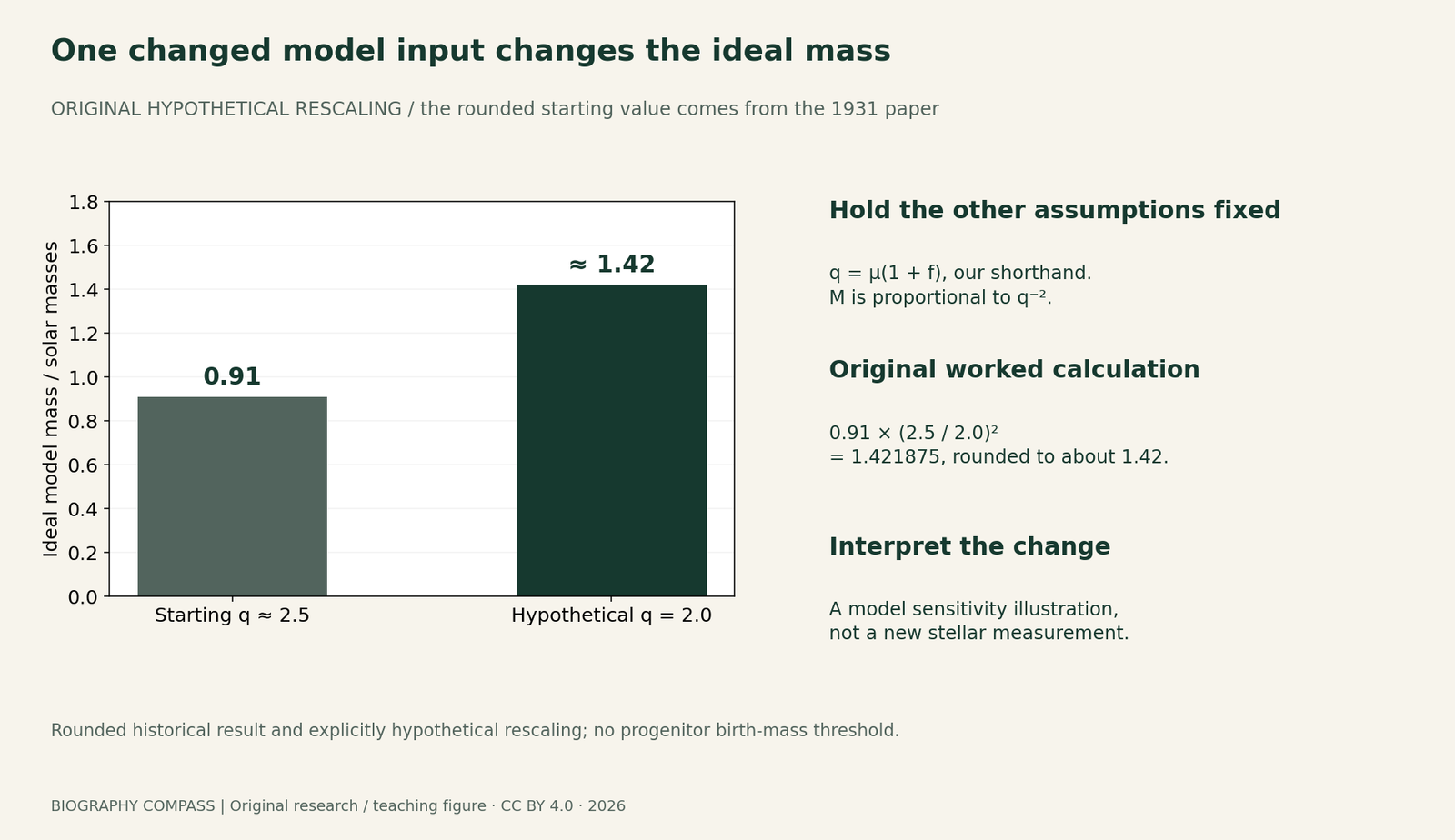
Write q = μ(1 + f) as a convenient label for the combination in the original electron-density equation. This is our shorthand, not a new measured quantity from the paper. Holding the other constants and polytropic assumptions fixed, the pressure coefficient K varies as q to the power −4/3. The mass relation printed on page 82 then makes the limiting mass proportional to K to the power 3/2, hence proportional to q to the power −2. This explains why a composition-related assumption can change the number even while the mathematical form of the ideal model stays the same.
Sources for this section: [1]
Original exercise: change one model input
For a deliberately simplified sensitivity exercise, take the paper’s rounded starting mass of 0.91 solar masses and approximate its starting q as 2.5. Suppose a hypothetical revised model uses q = 2.0 while all other assumptions and constants remain fixed. Calculate the ratio of the new mass to the old mass, then the new mass. Explain whether the calculation has measured a modern white dwarf, established an exact modern limit, or tested a new observational sample. Finally, say why replacing a remnant mass with a star’s birth mass would change the question being asked.
Sources for this section: [1]
Worked answer and what the arithmetic does not establish
The ratio is (2.5/2.0)² = 1.5625. Multiplying the rounded starting mass gives 0.91 × 1.5625 = 1.421875, or about 1.42 solar masses. The extra digits are intermediate arithmetic, not physical precision. We changed only a declared model input; we did not recompute every physical correction or obtain new observations. The exercise therefore illustrates sensitivity and should not be presented as a modern precision derivation. The mass being supported in the model is the compact remnant’s mass. Its relation to a progenitor’s birth mass requires additional stellar-evolution physics and mass-loss history.
Sources for this section: [1]
Read the date and the comparison as carefully as the equation
The paper ends with Trinity College, Cambridge, and a manuscript date of 12 November 1930; its journal publication is in 1931. A library stamp dated August 1931 is not a new research result or the date the calculation was written. Chandrasekhar also compares his result with Stoner’s earlier estimate, explaining that Stoner used a uniform-density assumption. This is an exchange between models, not evidence that all theoretical work began with one author. His later autobiography places the paper within a much longer sequence of research on stellar structure and subsequent subjects.
Continue the chronology
Related history guides
Hubble’s 1929 Velocity–Distance Paper: Calibration, Corrections and a Worked Example
Read Hubble’s original velocity–distance paper, distinguish solar-motion corrections and historical fits, then solve a fictional calibration exercise.
Read the timeline1931–1935How Deuterium Was Identified: Urey, Brickwedde, Murphy and the Spectral Evidence
Compare Urey’s account of deuterium’s spectral evidence, Brickwedde’s samples and Murphy’s observations, with an original evidence exercise and answers.
Read the timelineBiography context
Explore United Kingdom through connected lives
Connected biographies
Researchers behind the evidence

1910–1995
Subrahmanyan Chandrasekhar
Astrophysicist and scientific authorSubrahmanyan Chandrasekhar developed mathematical accounts of stars and their stability, then repeatedly moved into new fields. His work connected quantum statistics with relativity, while his teaching, books and journal editing shaped research at the University of Chicago.Read biographyQuick answers
Common questions
- Why does the 1931 paper give 0.91 instead of the familiar later number?
- Its numerical result belongs to the specific ideal assumptions and composition parameter used there. Our exercise isolates one dependence rather than deriving the complete modern value.
- Was this paper written in the United States?
- It is signed from Trinity College, Cambridge. The guide is also connected to the United States archive because of Chandrasekhar’s later Chicago career.
Primary and institutional sources
How this history was checked
Both original printed pages 81–82 were inspected, including their equations. The autobiography supplies career and publication context. The sensitivity calculation and figure are original teaching material, not a copied source figure or a new astrophysical measurement. This article was reviewed on 27 October 2026.