
The short answer
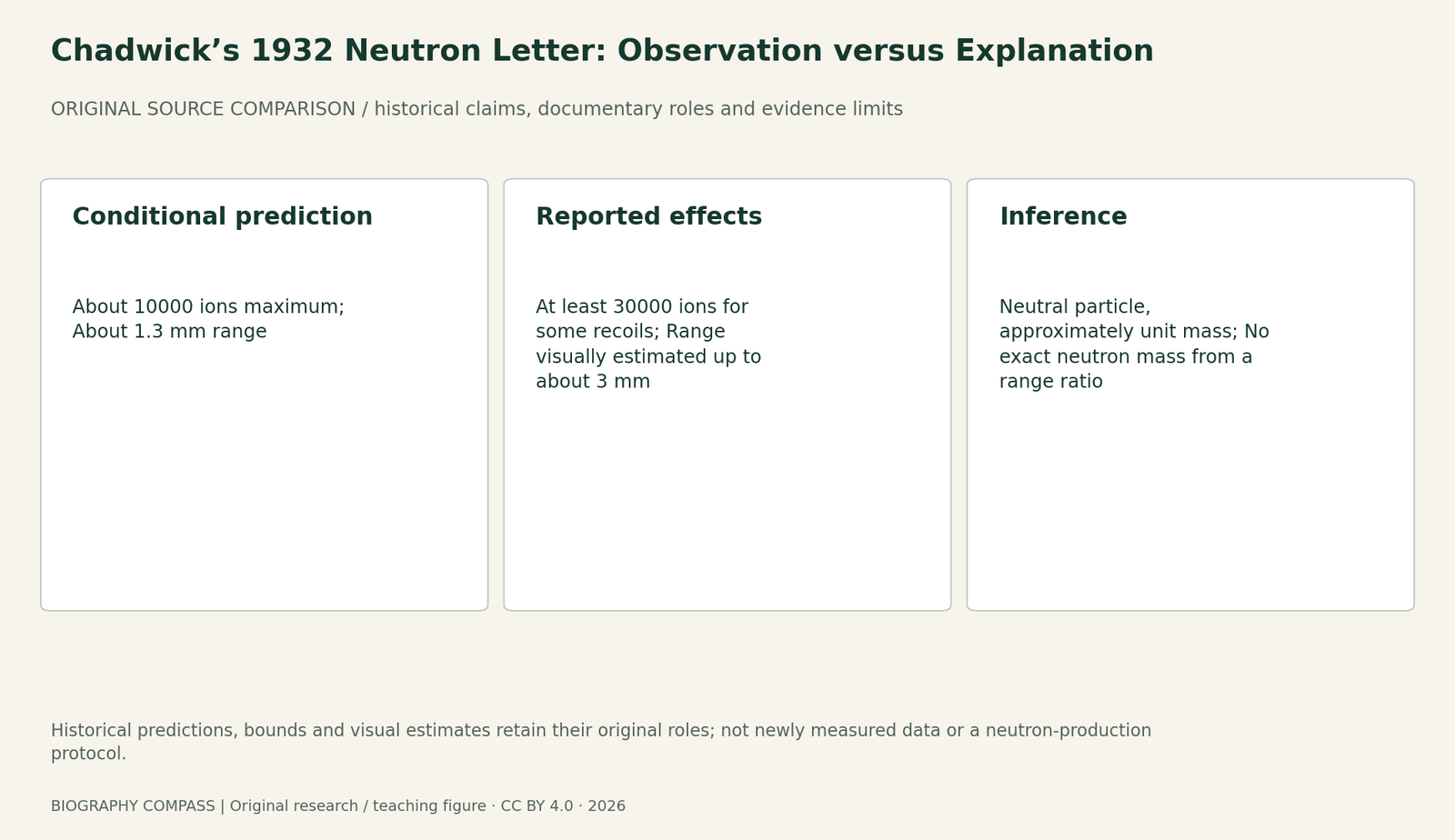
A neutral particle is difficult to detect directly. Chadwick’s 1932 letter compared the effects of beryllium radiation on other atoms, and asked which explanation could account for the recoils while conserving energy and momentum.
Evidence comparison
Read the role of each record
This original comparison follows the cited source scopes.
| Record | Evidence | What it supports | Limit |
|---|---|---|---|
| Quantum-account prediction | ≤ about 10000 ions; about 1.3 mm | Conditional consequence | Not a direct nitrogen measurement. |
| Reported recoil | ≥30000 ions; range sometimes about 3 mm | Tension with that account | Bounds and visual estimates retained. |
| Neutron account | Approximately unit mass; zero charge | Alternative collision explanation | Not a modern exact mass measurement. |
Chronology
A timeline of the turning points
Earlier radiation work
Bothe and Becker investigated beryllium radiation.
Letter
Signed 17 February; published 27 February.
Nobel lecture
Retrospective presentation followed the Physics Nobel.
The earlier observations were part of the discovery
Chadwick begins with Bothe’s work on penetrating radiation from beryllium and the Joliot-Curies’ observation that hydrogen-containing material produced ejected protons. Their proposed account treated the radiation as very energetic electromagnetic quanta. These were substantive earlier experiments, not incidental names in the final discovery story.
Chadwick extended the comparison to particles ejected from several elements. The letter describes recoil observations and credits collaboration with Norman Feather in an expansion chamber. Naming those contributions gives the reader a more accurate picture of how a new explanation became testable.
Compare a prediction with an observation
Under the stated quantum-recoil assumption, the letter predicted a nitrogen recoil with at most roughly 10000 ions and a range of about 1.3 mm at normal temperature and pressure. It reports some nitrogen recoils producing at least 30000 ions, and visually estimated ranges reaching about 3 mm.
These numbers have different epistemic roles: one pair follows from a proposed explanation; the other describes observed effects. The range was an estimate, and “at least” is a bound. Converting all four values into equally precise measurements would conceal the structure of Chadwick’s argument.
Sources for this section: [2]
Why a neutron was an explanatory alternative
Chadwick argued that neutral particles of approximately unit mass removed the difficulty while preserving energy and momentum in the collisions. He also discussed constraints on the energy available under the quantum account. The inference drew strength from a pattern across interactions, not from one number in isolation.
The letter’s cautious conclusion still favoured the neutron. Its 17 February signature and 27 February 1932 publication precede the 1935 Nobel lecture, which retold the sequence and credited earlier work. Later recognition should not be mistaken for the date of the initial report.
Original exercise: which statement follows?
Question 1: why is 30000÷10000=3 not an exact measured amplification? Answer: 10000 is the stated upper prediction under a model, and 30000 is a lower bound for some observations. The comparison indicates a discrepancy of at least about threefold for that ion-count argument, subject to the source’s approximations.
Question 2: does 3 mm÷1.3 mm≈2.31 give the neutron’s mass? Answer: no. It compares an estimated recoil range with a model-dependent prediction; the letter’s particle-mass inference requires collision and energy arguments. Question 3: what would a photograph of a recoil track show? Answer: an interaction product, not a direct photographic image of an uncharged neutron.
Sources for this section: [2]
Continue the chronology
Related history guides
Newton’s 1672 Prism Experiment: What Did the Second Prism Test?
Read Newton’s 1672 light letter, compare his prism tests and practise separating an observation from the inference that sunlight contains differently refracted rays.
Read the timeline1844–1859Darwin and Wallace in 1858: Authors, Documents and Communicators
Compare the 1858 Darwin–Wallace communication’s authors, document dates and editorial roles, with a source-table exercise and explained answers.
Read the timelineBiography context
Explore United Kingdom through connected lives
Connected biographies
Researchers and related lives
1891–1974
James Chadwick
Experimental physicistJames Chadwick established evidence for the neutron in 1932 and received the 1935 Physics Nobel Prize; his later career included Liverpool, Cambridge and wartime scientific leadership.Read biographyQuick answers
Common questions
- Did Chadwick photograph a neutron?
- The evidence concerned recoil particles and their interactions. The neutral particle’s existence was inferred.
- Was the neutron discovered in 1935?
- The letter was published in 1932; 1935 is the Physics Nobel year and the date of the lecture used here.
Primary and institutional sources
How this history was checked
Original source comparisons distinguish historical observations, interpretations and publication roles. Exercises are editorial learning materials, not newly performed experiments. This article was reviewed on 27 October 2026.
- James Chadwick; Nature 129, 312, 27 February 1932Possible Existence of a Neutron: publication record and opening extract
- James Chadwick; Principia document mirrorPossible Existence of a Neutron: complete one-page transcription
- James Chadwick; Nobel FoundationThe neutron and its properties: Nobel lecture, 12 December 1935