
The short answer
The NHS began on 5 July 1948 under Clement Attlee’s Labour government. Aneurin Bevan led the health legislation and negotiations, building on earlier proposals while changing their structure. Explaining the achievement means separating the idea of universal care, the law that authorised a service and the practical agreements that made it operate.
Three stages, not one event
What did each milestone change?
Ideas, legislation and a functioning service required different kinds of work.
| Milestone | What changed | What remained to do |
|---|---|---|
| 1942–1944 proposals | Comprehensive health provision gained a stronger place in reconstruction planning. | Agree ownership, administration, finance and professional terms. |
| 1946 Act | Parliament authorised the England-and-Wales service and ministerial responsibilities. | Organise institutions and negotiate the terms of participation. |
| 5 July 1948 launch | The new service began operating for patients. | Address inherited staff shortages, buildings, demand and spending. |
Chronology
A timeline of the turning points
Beveridge proposed comprehensive health provision
The report treated health and rehabilitation as necessary to a wider social-insurance settlement.
The coalition published a health-service White Paper
It accepted a comprehensive principle but proposed an organisation different from Bevan’s later settlement.
Attlee formed a Labour government
Bevan became Minister of Health with responsibility for turning the programme into legislation and administration.
Royal assent established the framework
The National Health Service Act 1946 covered England and Wales; implementation still required substantial negotiation.
Distinct territorial arrangements were established
Scotland legislated in 1947 and Northern Ireland in 1948; Bevan did not administer a single identical UK system.
The NHS began
Bevan’s visit to Park Hospital in Manchester marked the launch, while staff across the service delivered care.
Charging decisions tested the settlement
Dentures and spectacles were charged for in 1951; prescription charges began under the succeeding government in 1952.
Universal care had a history before the 1945 election
The principle that government should secure healthcare for everyone did not originate in a single cabinet meeting. Earlier reforms, wartime experience and proposals from social reformers had exposed gaps in access. The 1942 Beveridge Report placed comprehensive health and rehabilitation services alongside social insurance: illness could undermine income security even where cash benefits existed.
The wartime coalition’s February 1944 White Paper proposed a national service, with arrangements involving local authorities and voluntary hospitals. Acceptance of a broad principle did not settle who would own hospitals, employ doctors or pay for treatment. Those organisational questions explain how politicians could support comprehensive care yet disagree strongly about the legislation needed to provide it.
Attlee gave the programme cabinet authority; Bevan built the health settlement
After Labour won the 1945 election, Attlee appointed Bevan Minister of Health. The prime minister’s role was to sustain a legislative programme, manage competing ministers and support its financing. Bevan supplied the departmental leadership, parliamentary advocacy and bargaining needed to create a working service. Chancellor Hugh Dalton also mattered to its financial foundation.
The result was not simply Attlee’s personal blueprint handed down to hospitals. Nor was it Bevan acting outside government. Their responsibilities were connected but different. Public authority could establish an entitlement and reorganise institutions, while clinical work still depended on doctors, nurses and other staff whose professional cooperation no prime minister could manufacture by announcement alone.
The 1946 Act and the July 1948 opening were different milestones
The National Health Service Act 1946 received royal assent on 6 November. It provided for a comprehensive service in England and Wales, including prevention, diagnosis and treatment. National public ownership of hospitals was central to Bevan’s design. The Act’s passage established legal powers and duties, not a fully staffed service already admitting patients under the new arrangements.
The interval before 5 July 1948 was therefore part of the creation, not a two-year delay in celebrating something complete. Ownership, administration, professional terms and patient registration had to be arranged. Scotland and Northern Ireland had separate legislation and administrative responsibilities. Calling the project British is reasonable; describing the 1946 Act as one identical founding law for the entire United Kingdom is not.
Negotiations produced a mixed structure rather than one salaried workforce
Medical opposition focused partly on professional independence, remuneration and the organisation of practice. Bevan negotiated repeatedly with the profession before the launch. The government accepted that general practitioners would not be turned into a compulsory full-time salaried service. National funding consequently did not imply that every participant became a civil servant.
In England and Wales, hospitals were organised through regional boards, general practice operated on a contractual basis and local authorities retained community responsibilities. This settlement connected services without making their management identical. The distinction still helps readers understand the founding compromise: universal access concerned the patient’s entitlement, while ownership, employment and accountability could take several forms behind the same public-service promise.
The launch changed access more quickly than it could change capacity
On 5 July 1948 Bevan visited Park Hospital in Manchester to mark the beginning. The new principle was that necessary care should not depend on a patient producing a fee at the moment of treatment. For people who had postponed dental, optical or medical attention, that was a material change in the relationship between household income and illness.
It was not an overnight expansion of buildings and trained staff. Nuffield’s institutional history emphasises the inherited shortages, and contemporary government publicity soon warned patients not to expect miracles. The National Archives reproduces examples of those messages. They show officials promoting a new entitlement while trying to manage demand within existing resources; the promise of access and the problem of capacity were present together from the start.
Early charging disputes were about priorities as well as accounting
Spending pressure produced conflict within Attlee’s government, particularly as defence demands increased during the Korean War. Bevan resigned in 1951 over the direction of policy, including charges for dentures and spectacles. This was a dispute about how a welfare commitment should be protected when the Cabinet faced several expensive obligations, not proof that the NHS had never been a public service.
Prescription charges require a separate chronology. Earlier legislation created powers to charge, but actual prescription charging began in 1952 under the Conservative government. Conflating those dates wrongly assigns every later restriction to the founding Labour administration. The lasting significance of 1948 lies in a new framework for entitlement and responsibility, not a claim that every service would remain unchanged or entirely free of all charges forever.
Continue the chronology
Related history guides
Biography context
Explore United Kingdom through connected lives
Connected biographies
Read the political lives behind reconstruction
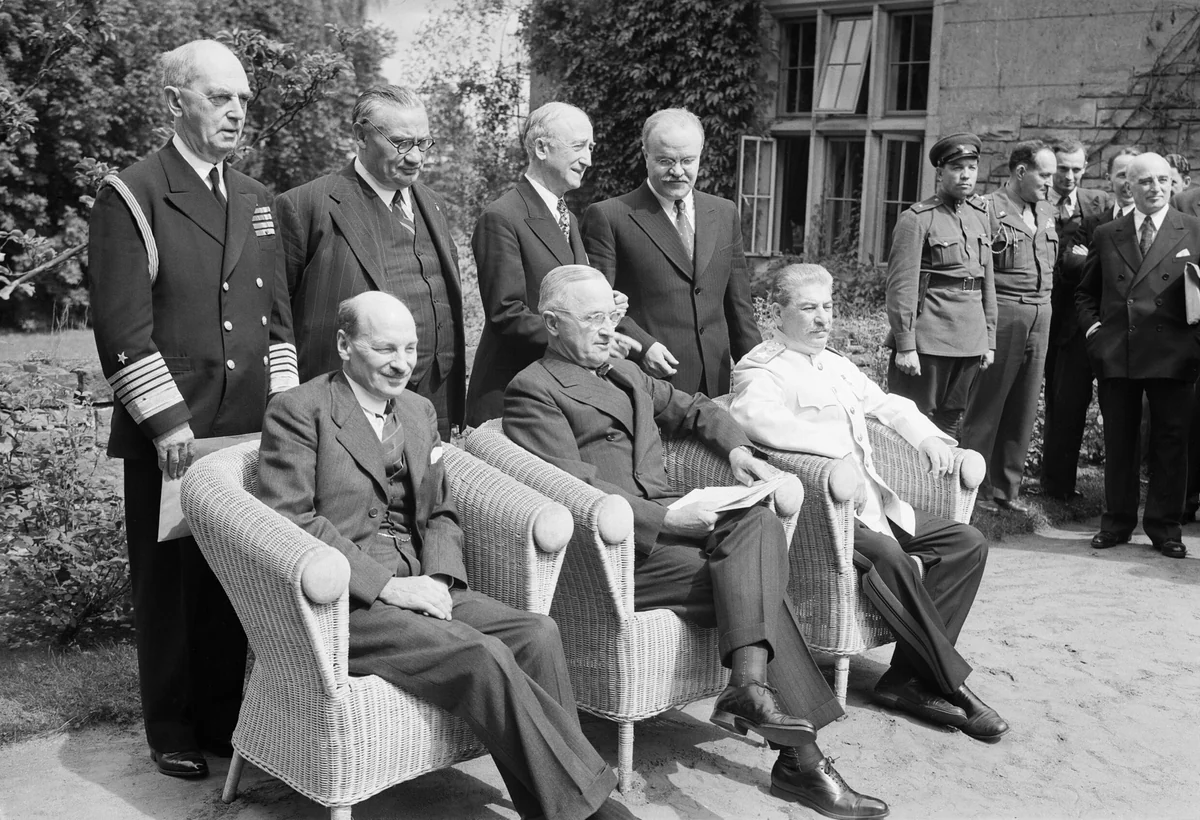
1883–1967
Clement Attlee
British prime minister and Labour leaderClement Attlee was British prime minister from 1945 to 1951 and Labour leader from 1935 to 1955. His governments established the NHS, expanded social insurance and nationalised major industries while confronting austerity, imperial withdrawal and the emerging Cold War.Read biography
1874–1965
Winston Churchill
British prime minister and writerWinston Churchill was British prime minister in 1940–1945 and 1951–1955. His resistance to Nazi Germany and wartime diplomacy were decisive parts of a much longer career involving political reversals, military failures, writing and imperial power.Read biographyQuick answers
Common questions
- Who founded the NHS: Attlee or Bevan?
- Attlee’s Labour government established it. Bevan led the health legislation and negotiations as Minister of Health, supported by cabinet authority and earlier work on comprehensive care.
- Was the NHS created in 1946 or 1948?
- The National Health Service Act 1946 received royal assent in November 1946. The service began on 5 July 1948 after further negotiation and preparation.
- Did the 1946 NHS Act cover all of the UK?
- No. It covered England and Wales. Scotland and Northern Ireland had separate founding legislation and responsibilities.
- Did every NHS doctor become a salaried government employee?
- No. General practitioners retained an independent contractual position. Public funding and universal access did not require one employment model for every part of the service.
- Were prescription charges introduced by Attlee in 1951?
- No. Powers to charge predated their implementation, but actual prescription charging began in 1952 under the succeeding Conservative government. Denture and spectacle charges belong to 1951.
Primary and institutional sources
How this history was checked
Parliamentary accounts establish the statute’s correct name, territorial scope and commencement. The Commons Library post occasionally reverses the words in the Act’s title; that typographical error is not repeated. The Lords briefing and Nuffield history distinguish the founding settlement from subsequent charges. National Archives publicity was available in its indexed article extract; the full underlying cabinet files are not claimed as inspected. This is institutional history, not advice about present-day healthcare eligibility or charging rules. This article was reviewed on 23 October 2026.
- UK Prime Minister’s OfficeHistory of Clement Attlee
- UK Parliament, Parliamentary Archives1946 NHS Act: England and Wales and the 1948 commencement
- Geoffrey Rivett / Nuffield Trust1948–1957: Establishing the National Health Service
- Andrew Mackley / House of Commons LibraryThe political foundations of the NHS
- Michelle Clement / UK History of GovernmentThe founding of the NHS: 75 years on
- House of Lords LibraryNational Health Service: 70th Anniversary, June 2018
- The National ArchivesThe foundation of the NHS: contemporary publicity and demand