
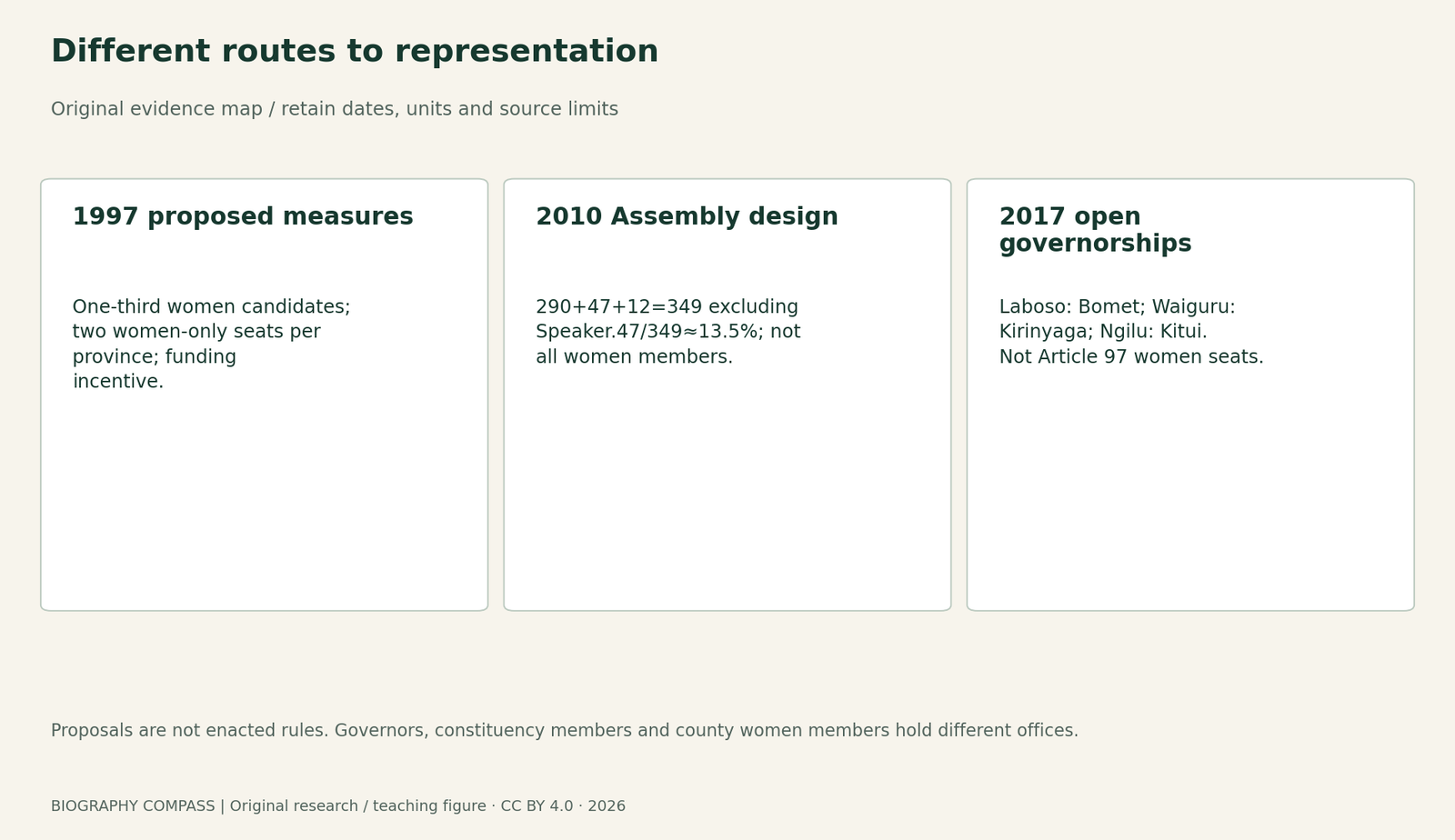
The short answer
Do a candidate quota, a reserved parliamentary seat and an elected woman governor measure the same thing? Read Asiyo’s original motion beside the later Constitution and IEBC’s election record to see why they do not.
Name the mechanism
Candidates, membership and executive office
Similar political goals can operate through different legal and electoral routes.
| Country | Mechanism | Relevant unit | What it does not establish |
|---|---|---|---|
| 1997 nomination proposal | Women as at least one-third of party candidates | Candidate pool | One-third of election winners |
| Article 97 women seats | 47 county-elected women in the National Assembly | Parliamentary membership | A reserved governor post |
| Article 177 special seats | County assembly membership after ward results | Assembly gender balance | A national parliamentary seat |
| Article 180 election | County voters choose governor | Open executive contest | Election through a women-only seat |
Chronology
A timeline of the turning points
Asiyo’s motion
Three measures addressed candidates, reserved seats and party funding.
Constitutional design
General gender principles and separate membership mechanisms appeared in the adopted Constitution.
Open gubernatorial victories
IEBC records Laboso, Waiguru and Ngilu as elected governors.
Begin with the original motion
The morning Hansard for 23 April 1997 records Phoebe Asiyo moving a motion on women’s participation in politics. It recommends legislation on party nominations, a constitutional amendment for women-only seats and a funding incentive. These are three different proposed interventions. The opening verb matters: Parliament was being asked to recommend further governmental and legislative action. The text is not itself an enacted constitutional amendment. The inspected morning debate establishes what Asiyo proposed and how she explained it; it does not, by itself, establish the motion’s final division or every later attempt to legislate on the subject.
Sources for this section: [1]
Compare candidate rules with guaranteed seats
The first proposal would require parties to nominate at least one-third women candidates. That addresses access to the ballot, not the final distribution of winners. The second would create two parliamentary seats exclusively for women in each province. Asiyo’s explanation explicitly gives sixteen seats across eight provinces and says these would not redraw existing constituency boundaries. The third links public party funding to the proportion of women candidates. A candidate requirement, a seat reservation and a financial incentive can work together, but they cannot be counted as if they were the same numerical guarantee. Preserve the denominator each measure addresses.
Sources for this section: [1]
The 40–25 division was on an amendment
The same debate contains a further distinction on printed page 352. A division defeated an amendment by 40 votes to 25. The chair then returned to Asiyo’s original motion and, responding to a challenge about the vote, explicitly clarified that members had been voting on the amendment rather than for or against the original motion. The amendment and the motion therefore cannot share that vote count automatically. This is a useful safeguard when a later summary quotes a number without its procedural context. It does not establish the final disposal of the original motion beyond the proceedings inspected here.
Sources for this section: [1]
Read the later general principle separately
Articles 27(8) and 81(b) of the 2010 Constitution express the principle that no more than two-thirds of members of the relevant bodies should be of the same gender. This concerns the membership of a body, rather than only the pool of candidates. It is also expressed as a ceiling on either gender, not as a statement that every individual office is reserved for a woman. This guide reads the original constitutional design historically. It does not provide a current legal opinion on all compliance disputes, court remedies or subsequent legislative proposals, which would require a broader and more recent legal review.
Sources for this section: [2]
The 47 county women members sit in the National Assembly
Article 97 specifies 290 constituency members, 47 women elected by county voters, twelve nominated special-interest members and the Speaker. The county electorate for the 47 women’s seats does not make those members county assembly members or governors. Article 97(2) also preserves eligibility to contest the general constituency seats. Women’s representation therefore cannot be measured simply by counting the reserved county seats. Additional women may win constituency contests or enter through nomination. The constitutional categories describe routes to membership; an election report supplies the actual winners and must be read with its own date and scope.
County assemblies and governors have different routes
Article 177 provides special seats in county assemblies to ensure the stated gender balance after ward results, allocated through the party-list process. Article 180 instead provides direct election of a governor by county voters. In the IEBC’s 2017 report, table 11 lists three women elected governor: Joyce Laboso in Bomet, Anne Waiguru in Kirinyaga and Charity Ngilu in Kitui. Ngilu is listed for NARC. Those victories were in open executive contests, distinct from the National Assembly county women seats and the county assembly mechanism. Calling every woman elected by county voters a women representative would erase the actual office and its powers.
Exercise: test the denominator
A hypothetical civic display claims: “Forty-seven reserved seats guarantee that one-third of the 349 non-Speaker National Assembly members are women; Ngilu’s governorship is one of those seats.” Audit both assertions. First calculate 47 divided by 349, using the constitutional categories to show where the denominator comes from. Then identify which article and election table locate Ngilu’s office. Finally explain why even a party selecting one-third women candidates would not alone prove that one-third of its successful candidates were women. The exercise concerns institutional categories and elementary arithmetic; it does not ask you to declare a real Parliament legally compliant or noncompliant.
Reference answer: count people in the right institution
The non-Speaker total is 290 + 47 + 12 = 349. Forty-seven divided by 349 is approximately 13.5 per cent, so those seats alone do not guarantee one-third of that total. This is not the actual share of all women members, because women can also enter other categories. Ngilu appears in IEBC table 11 as a Kitui governor, an office governed by Article 180, rather than one of the Article 97 seats. A candidate share also does not determine a winner share: the latter depends on which candidates win. These corrections preserve the difference between constitutional design, electoral participation and observed representation.
Research continuity without inventing a single author
Asiyo’s motion makes an important earlier intervention visible, while Ngilu’s career shows a woman contesting presidential, constituency and county executive elections. Neither record establishes that one politician personally authored every later gender provision or that one election completed the work of political inclusion. A stronger comparison asks which institutional barrier a particular proposal addressed, which rule was actually adopted and which result can be demonstrated. Keep the 1997 text, 2010 provisions and 2017 election table on separate lines. That method gives readers a precise account of continuity and change without treating different proposals as interchangeable or claiming a causal chain that these records alone cannot prove.
Continue the chronology
Related history guides
Biography context
Explore Kenya through connected lives
Connected biographies
Lives connected with the records
1932–2025
Phoebe Asiyo
Kenyan parliamentarian and advocate for women’s representationPhoebe Asiyo moved from teaching and public service into Parliament and women’s organizing. Her 1997 motion linked candidate selection, reserved seats and public funding to the problem of women’s political exclusion.Read biography1952–
Charity Ngilu
Former Kenyan cabinet minister and governor of KituiCharity Ngilu entered Parliament for Kitui Central in 1992, contested the presidency in 1997 and held national cabinet portfolios before winning Kitui’s governorship in 2017.Read biography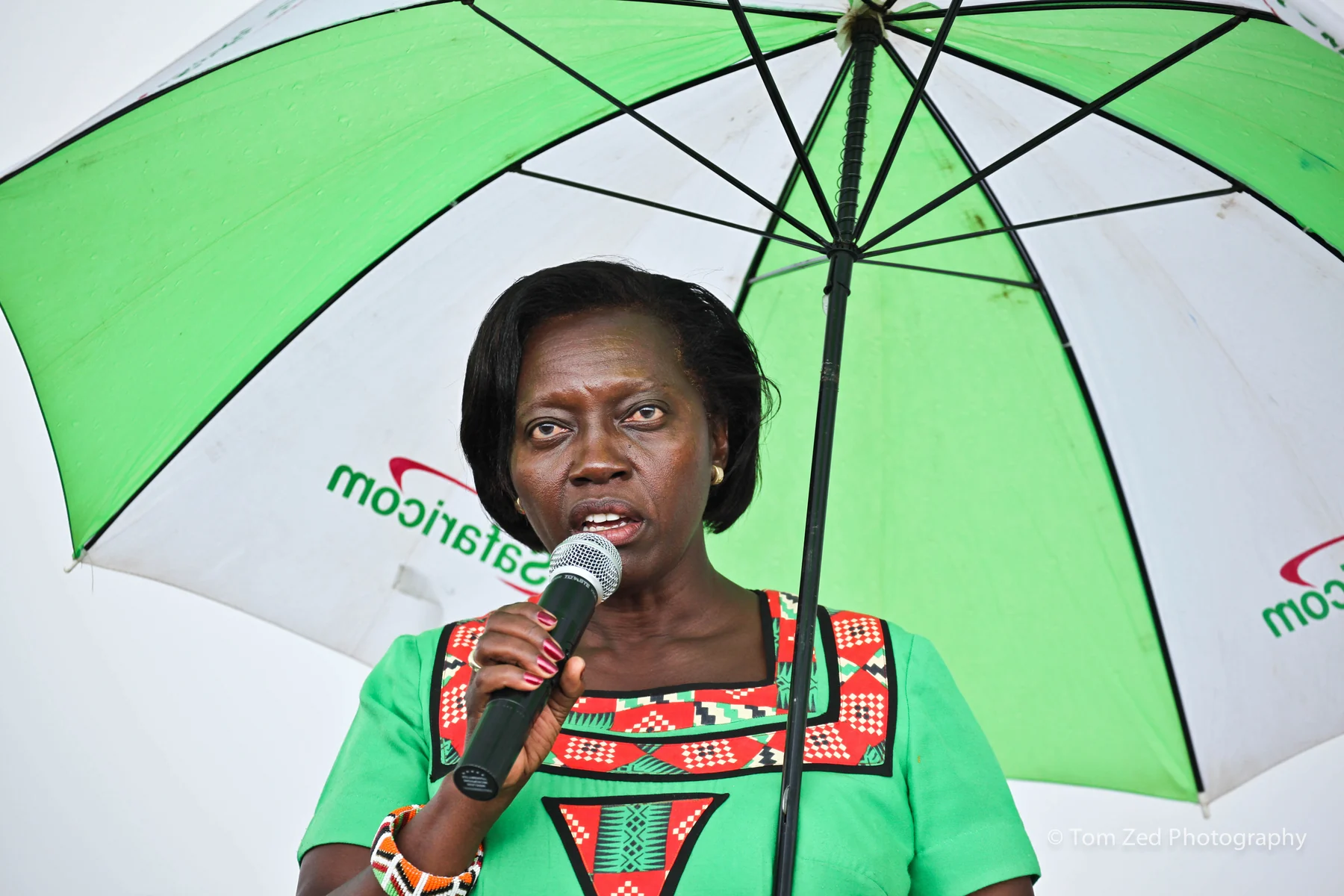
1957–
Martha Karua
Lawyer, former magistrate, MP and Cabinet minister;2022 deputy-presidential candidateMartha Karua moved from the magistracy and private practice into multiparty activism, Parliament and Cabinet. Her later campaigns included the presidency, Kirinyaga governorship and the 2022 deputy-presidential ticket with Raila Odinga.Read biographyQuick answers
Common questions
- Were the 1997 proposal and 2010 provisions identical?
- No. Asiyo explained sixteen women-only seats and candidate/funding measures. The Constitution later used different membership structures.
- Are county women representatives governors?
- No. The 47 county women members sit in the National Assembly under Article 97; governors are elected under Article 180.
Primary and institutional sources
How this history was checked
Identify what each inspected record establishes and keep its date, purpose and limits visible. This article was reviewed on 27 October 2026.
- Parliament of KenyaNational Assembly Hansard, 23 April 1997 morning, Participation of Women in Politics, printed pages 340–344
- Republic of Kenya, Ministry of Defence online textConstitution of Kenya 2010, Articles 27, 81, 97, 98, 177 and 180
- Independent Electoral and Boundaries Commission2017 General Election data report, tables 10–11, page 11
- Kenya Parliament LibraryBio data for the Members of the Cabinet that Served the Tenth Parliament: Charity Kaluki Ngilu, PDF page 34