
The short answer
What changes when psychiatric care enters an existing village? Compare who provided work, who carried costs and whose experience remains missing from the available records.
Original source comparison
Match each question to a suitable record
Descriptions of organisation and claims about outcomes need different evidence.
| Country | What the evidence supports | What it does not establish |
|---|---|---|
| How was care organised? | Institutional description and dated service records. | Every participant’s experience. |
| Who paid? | Lodging rules,accounts and family budgets. | That a lower hospital cost meant no cost elsewhere. |
| What did people prefer? | Attributed patient and family testimony. | A universal answer from one professional letter. |
| Did outcomes improve? | Defined cohorts,follow-up,comparison and context. | A causal conclusion from residence alone. |
Chronology
A timeline of the turning points
Leadership appointment
Hospital history dates Lambo’s arrival.
Specified programme milestone
The hospital dates the village innovation separately.
Professional comparison
Adewunmi’s letter compares a historical community arrangement with north Powys.
Online posting
Digital publication date is distinct from the original issue.
Identify the voices before reconstructing the programme
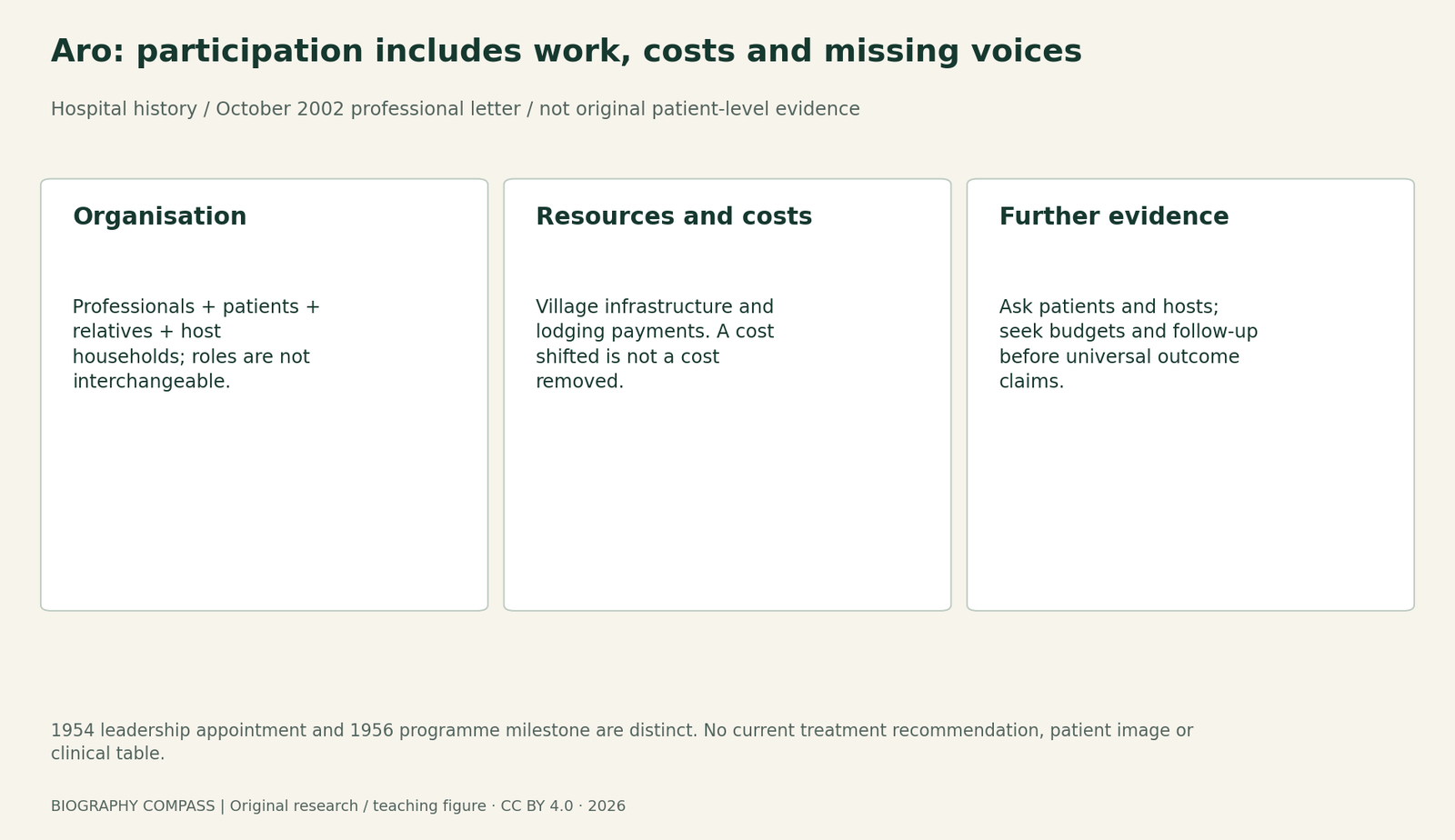
Two records lead this comparison: the Aro hospital’s retrospective institutional history and Ade Adewunmi’s letter Community Psychiatry in Nigeria in the October 2002 Psychiatric Bulletin. A later online posting date of 2018 does not turn the letter into a 2018 field study. The history explains how the hospital remembers its development; the letter compares Aro with an accommodation scheme in rural Wales. Neither is an acquired set of patient case files. Their different purposes allow a substantive historical question: how was community participation organised, and which claims would need additional evidence?
Separate an appointment from the beginning of a practice
The hospital account places Lambo’s arrival in 1954, after earlier work at Lantoro and acquisition of the Aro site. It gives 1956 for the village-management innovation. Retrospective summaries sometimes attach 1954 to the broader programme. Preserve what each date labels rather than averaging them or inventing an undocumented pilot phase. A service can acquire land, open buildings, appoint leadership and change its practice at different times. The 1950 sprovide a supported broad period; an exact founding day for the village system is not established by the consulted material.
Village participation included professional and domestic labour
Aro’s account describes patients living in nearby villages with relatives, alongside other residents, while nurses and clinical services continued. The 2002 letter emphasises negotiation with community leaders and adaptation of existing village infrastructure. These are different kinds of contribution. A clinician can assess and supervise; a relative can provide daily support; a host household supplies accommodation and relationships; local leadership helps sustain acceptance. Replacing all those actors with the phrase Lambo treated patients would erase how the arrangement worked. Community care did not mean the absence of institutions or specialised labour.
Integration could carry costs as well as benefits
Adewunmi notes that patients and families paid for lodging, that stays could last years and that some people settled permanently. These details complicate an easy story of care simply becoming cheaper or moving everyone quickly home. A cost may shift from a hospital budget to a family without disappearing. Likewise, residence in a village is not automatically the same outcome as return to a previous household. The letter’s discussion of community confidence is an interpretation by a professional writer. Patient, relative and host-household testimony would be needed to investigate how different participants experienced the arrangement.
Sources for this section: [2]
The international comparison is a proposal, not an equivalence
The letter responds to a report about accredited accommodation in north Powys. It sees a historical parallel in using existing community resources, while acknowledging different periods and cultural settings. That comparison can generate useful questions about accommodation, trust and responsibility. It does not establish that the two services had identical staffing, eligibility, financing or results. A research design should specify those features before comparing outcomes. The referenced earlier Aro studies are a further documentary trail; this guide has not independently read all of them or reconstructed the original patient cohorts.
Sources for this section: [2]
Exercise: build a record request from five claims
Classify these statements as supported description, attributed interpretation or a claim needing further evidence: nurses worked within the arrangement; families paid lodging costs; every family saved money; every patient preferred village residence; community liaison helped sustain confidence. For each unsupported universal claim, identify at least two records or voices to seek. Then write a short research question about whose work became visible in the hospital’s history. Avoid designing a treatment recommendation: the task is to explain the historical organisation and to distinguish its record from a complete assessment of outcomes.
Reference answer: an institution’s account is a starting point
Nursing and family lodging payments are described by the consulted records. Community confidence is the letter writer’s interpretation and should remain attributed. Universal financial savings and patient preference are not established. Accounts with comparable cost categories, family budgets, dated interviews and records of admission or departure would help investigate those questions; no single source automatically supplies the whole answer. A useful research question could ask how host households’ and relatives’ labour appeared in official descriptions compared with their own testimony. The remaining gaps are specific rather than an excuse to declare the whole history either a success or a failure.
Connected biographies
People behind the work
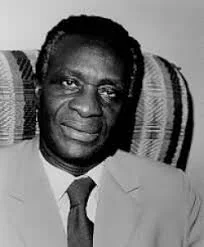
1923–2004
Thomas Adeoye Lambo
Psychiatrist, university leader and international health officialThomas Adeoye Lambo connected psychiatric research with Nigerian communities, university teaching and international health administration. His work at Aro and Ibadan challenged the assumption that specialist care had to be separated entirely from ordinary social life.Read biographyQuick answers
Common questions
- Is this a recommendation for current psychiatric care?
- No. It is a historical document-reading guide, not a clinical evaluation or treatment plan.
- Were the original patient files or all cited studies inspected?
- No. The guide identifies the records actually read and the further evidence needed.
Primary and institutional sources
How this history was checked
Compare the identified original texts, participant accounts and institutional records; the teaching examples are separately labelled. This article was reviewed on 27 October 2026.
- Federal Neuropsychiatric Hospital, AroAbout Neuropsychiatric Hospital Aro Abeokuta, institutional history
- Ade Adewunmi; Royal College of PsychiatristsCommunity Psychiatry in Nigeria, Psychiatric Bulletin26(10),394–395, October2002
- Femi Oyebode; Royal College of PsychiatristsThomas Adeoye Lambo: obituary, Psychiatric Bulletin28,469,2004
- Pontifical Academy of SciencesThomas Adeoye Lambo: deceased academician record