
The short answer
Why does a story about a landlord’s son and a household worker become a drama about an entire social order? Ankur makes ordinary transactions—food, wages, hospitality and desire—reveal unequal power. This guide discusses the ending.
Chronology
A timeline of the turning points
Ankur reaches audiences
Benegal’s first feature establishes Azmi as Lakshmi opposite Anant Nag and Sadhu Meher.
National recognition
Ankur brings Azmi her first National Film Award and becomes associated with parallel cinema.
A caste-focused rereading
Prashant Kadam examines the potter-caste identification and interviews Benegal about its regional context.
An archival record
NFAI’s digitised-and-restored films list includes the 1974 film, catalogued as Hindi with English subtitles.
Fiftieth-anniversary criticism
New essays revisit the film’s performances, social relations and visual construction.
Which debut, and whose film?
The BFI records Ankur as a 1974 Indian film directed by Shyam Benegal and produced by Mohan J. Bijlani and Freni M. Variava. It was Benegal’s first feature and the released film that established Shabana Azmi. Calling it a debut should not imply that neither artist had worked or trained before: Azmi came from FTII, while the director brought earlier professional experience.
Azmi plays Lakshmi, Anant Nag the landowner’s son Surya, and Sadhu Meher her husband Kishtayya. Priya Tendulkar plays Surya’s wife. These roles form a household and labour relationship before they become a love triangle. Keeping the ensemble in view prevents the film from being reduced to a star’s discovery or the achievement of its director alone.
Land, work and the limits of apparent liberalism
Surya arrives from the city to manage his father’s rural estate. Lakshmi and Kishtayya depend on work within a system whose land and resources they do not control. His urban habits can initially suggest distance from village prejudice. Yet the power to employ, dismiss and punish remains his, regardless of whether he presents himself as personally enlightened.
Stuart Blackburn’s study connects economic and sexual exploitation through that ownership structure. Food is especially revealing: a small quantity of rice means something different to a hungry household than it does to someone controlling the store. The story therefore asks more than whether Surya is kind on a particular day. It asks what protects a worker when the powerful person’s inclination changes.
Sources for this section: [8]
The tea scene makes caste audible
Prashant Kadam’s essay focuses on an early exchange in which Lakshmi hesitates to make Surya tea because of her caste. She identifies her household as Kumhar, associated with pottery. What could look like a minor domestic request makes rules about touch, cooking and social rank audible. The scene’s ordinary scale is precisely why it matters: hierarchy is reproduced within daily service.
Kadam also challenges the loose interchange of Kumhar and Dalit in summaries. He reports Benegal’s explanation that the potter community faced untouchability in the Telangana context he depicted. This regional account should not be turned into a universal caste classification. Naming the tension produces a more accurate reading than either erasing caste or assuming that every caste label has the same meaning everywhere.
Sources for this section: [5]
Desire does not cancel unequal power
Lakshmi’s relationship with Surya develops within dependence, loneliness and unequal social standing. When his wife arrives and Lakshmi becomes pregnant, the promises of protection prove fragile. Treating the events only as an illicit romance would obscure why each person can make different choices, and why the consequences fall so unevenly.
Aditi Bhardwaj’s review emphasises Surya’s contradictory character rather than presenting him as an entirely separate species of villain. He is himself constrained by a domineering father while exercising authority over people below him. That combination does not excuse his conduct. It shows how a person can experience restriction in one relationship and reproduce domination in another, carrying the hierarchy forward.
How the images make inequality visible
Pradip Biswas draws attention to Govind Nihalani’s cinematography: the bleached material of Lakshmi’s small home contrasts with the estate’s green fields, while scant household rice contrasts with large stored sacks. These are relationships between things shown, not merely background decoration. An account of poverty becomes more concrete when the viewer can compare scarcity and abundance within the same social landscape.
The Wire’s review notes another visual relationship: Surya appears behind window bars after his father blocks his educational ambition. The image gives confinement a form without making his position equivalent to Lakshmi’s. Such differences matter. A film can register several characters’ frustration while preserving the enormous disparity between their control of resources, their exposure to punishment and their ability to leave.
A voice, a stone and an unresolved future
When Kishtayya returns and approaches Surya for work, Surya mistakes his purpose and has him beaten. Lakshmi’s angry defence of her husband changes the film’s distribution of speech and silence. The concluding child’s stone through a window is a small action against property and authority, not a filmed account of a completed revolution.
The title, meaning seedling, encourages attention to beginnings: a desired child, a newly forceful voice and the possibility of resistance. None guarantees what will follow. That open future helps explain the film’s continuing place in criticism of parallel cinema. It is significant without being the first Indian film to address injustice, and its ending remains forceful because an individual protest has not magically repaired the structure exposed by the story.
Biography context
Explore Telangana region, India (part of Andhra Pradesh when the film was released) through connected lives
Connected biographies
The actor beyond her debut
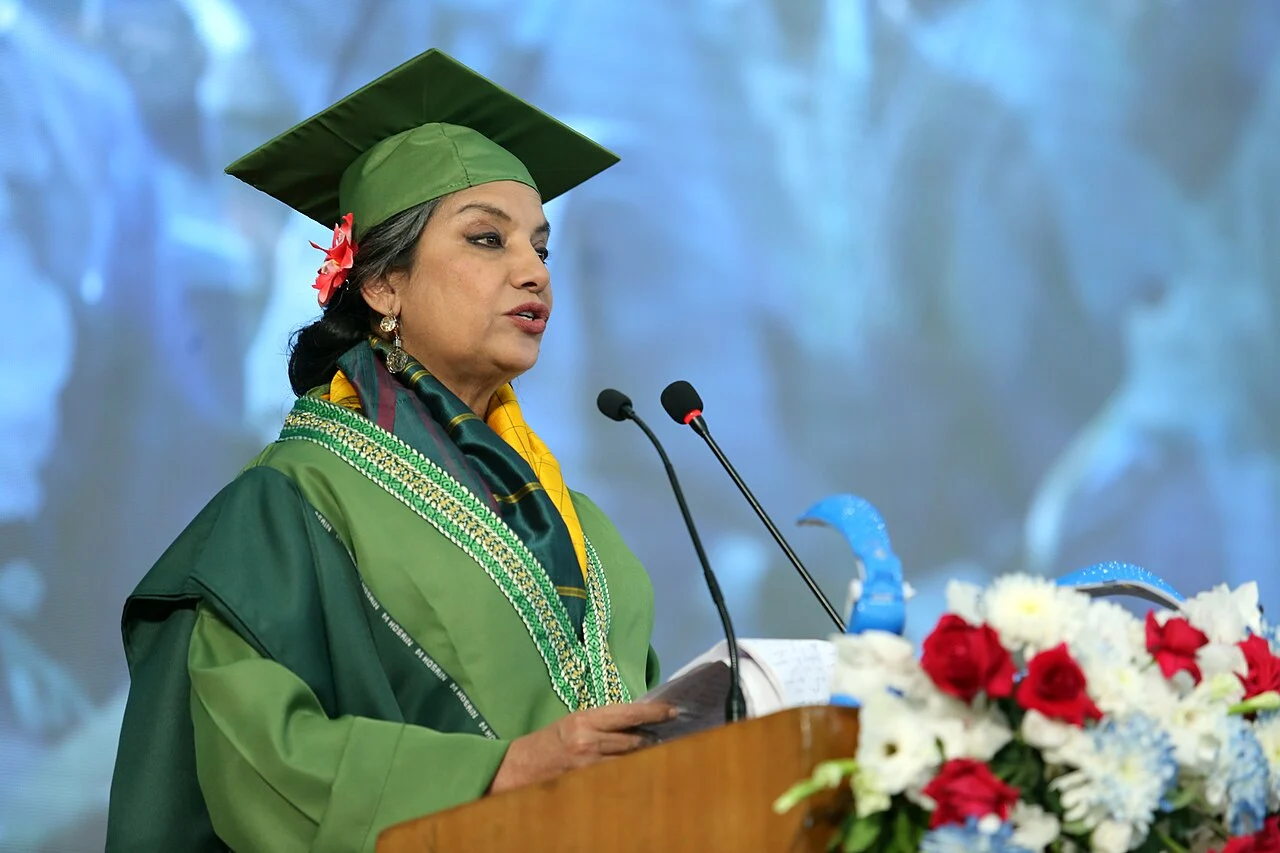
1950–
Shabana Azmi
Film, television and theatre actor; social activist and former parliamentarianShabana Azmi built a career across Indian parallel cinema, commercial films, theatre and television while advocating housing, women’s rights and pluralism.Read biographyQuick answers
Common questions
- Who directed Ankur?
- Shyam Benegal directed the 1974 film. The BFI names Mohan J. Bijlani and Freni M. Variava as producers.
- Who are the principal actors?
- Shabana Azmi plays Lakshmi, Anant Nag plays Surya, Sadhu Meher plays Kishtayya and Priya Tendulkar plays Surya’s wife.
- Is Ankur simply a story about adultery?
- No. Its relationships depend on land, employment, caste and gender. Those structures determine who can offer protection and who bears the consequences when it is withdrawn.
- Does the last scene resolve the conflict?
- No. The child’s stone signals anger and possible resistance. It does not show the social order overturned or the characters’ problems solved.
Primary and institutional sources
How this history was checked
The guide uses film and archival records, published interviews and scene-specific criticism; it does not claim a new complete viewing. No film dialogue, screenplay passages or rights-reserved stills are reproduced. This article was reviewed on 23 October 2026.
- British Film InstituteAnkur: 1974 record, director, producers and running time
- National Film Archive of IndiaDigitised and restored films list, 16 December 2016
- United Nations Population FundAzmi’s 1998 appointment: Ankur and first National Award
- Film and Television Institute of IndiaAzmi’s 1971 acting batch: golden-jubilee record
- Prashant Kadam / Himal SouthasianRe-viewing the seedling, 1 April 2010: accessible caste discussion
- Pradip Biswas / FIPRESCI IndiaAnkur: 50-Year-Live, 2024, selected cast, image and ending analysis
- Aditi Bhardwaj / The WireRemembering Ankur, 24 December 2024: character and visual analysis
- Stuart Blackburn / Humanities InstituteAnkur: study of story, economic power and ending
- Wikimedia Commons / Ifthekhar OmerLater BRAC convocation photograph: exact rights record
- BRAC University2016 convocation: pictured event identity