
The short answer
The narrator can know a place before travelling there and fail to understand an event long after it happens. The Shadow Lines makes that uneven knowledge central to family history. This guide discusses Tridib’s death and other major outcomes, drawing on selected permitted pages and named criticism.
Chronology
A timeline of the turning points
A journey before the narrator’s birth
The opening begins with Mayadebi and Tridib travelling to England.
Places arrive through stories
Tridib’s descriptions become part of the narrator’s imagined geography.
A fatal journey to Dhaka
The family’s attempt to recover a connection with home meets communal violence.
Knowledge is reconstructed
Different voices disclose details the narrator did not originally understand.
Publication and later edition
The 1988 novel precedes the 1989 Viking edition reviewed by Kirkus.
The opening makes knowledge older than experience
The permitted opening pages begin with a 1939 journey made before the narrator was born. He then notices the difference between writing Mayadebi’s name and the kinship name he has used aloud. Before a conventional plot settles into place, the telling itself becomes visible.
This opening asks a practical question: how can something we did not witness become vivid and intimate? Family stories supply images, but names and relationships also shape their authority. The narrator is not merely transmitting a finished record; he is examining the terms on which he has come to know it.
Sources for this section: [1]
Tridib offers a method for imagining elsewhere
The publisher synopsis describes a boy encountering the world through a cousin, a grandmother and a London family. Tridib’s stories make another place available before physical travel. The narrator’s relation to distance is therefore learned through attention and imagination as well as geography.
Do not reduce that process to the idea that invented places are as good as real ones. The question is what kind of care makes an imagined place answerable to another person’s experience. Track what the narrator has actually seen beside what he knows from someone else’s account.
Tha’mma wants a border she can recognise
Alessia Polatti’s study examines the grandmother’s expectation that a national border should have a visible sign. The quoted novel passages place birthplace, nationality and the language of coming and going into a troubling relationship. A journey home no longer has an obvious direction.
The resulting problem is more than a mistaken map. If home is defined through remembered kinship and a familiar house, a new passport category cannot simply replace it. Compare the grandmother’s desire for a stable location with Tridib’s and the narrator’s more mobile understandings of space.
Sources for this section: [3]
A line can be imagined and still kill
Polatti relates Tridib’s death in the 1964 Dhaka violence to the novel’s treatment of Partition. The arbitrariness of a boundary does not make its consequences unreal. People organise belonging, suspicion and violence around distinctions that cannot be read directly from the landscape.
Ask what changes when a person is classified as belonging elsewhere. The novel’s family connections cross political divisions, yet those connections do not offer automatic protection. Its account unsettles a simple choice between believing in national borders and pretending that they have no material force.
The order of telling is part of the meaning
Kirkus’s review describes events disclosed through others’ accounts and finds the chronology both fascinating and potentially confusing. That response identifies a real demand on the reader: the time of an event and the time of learning about it may be far apart.
Keep two brief chronologies while reading—what happened and when the narrator understood it. The gap helps reveal how loss, incomplete testimony and imagination shape a family history. A conventional plot summary is useful for orientation, but it cannot replace the experience of delayed knowledge.
Sources for this section: [5]
Separate the author’s explanation from critical interpretation
Ghosh’s 1995 essay links the novel’s origins to his response to Delhi’s 1984 violence and his reluctance to turn suffering into spectacle. That is a statement of artistic intention. Polatti’s account of home in movement and Kirkus’s account of narrative memory are later judgements about the resulting work.
The guide has consulted permitted opening pages and selected passages quoted in criticism, not undertaken a complete new reading. The John Murray page’s 2011 date and Kirkus’s 1989 date identify editions. Neither replaces the novel’s 1988 first-publication year.
Continue the chronology
Related history guides
Biography context
Explore Fictional family lives in Calcutta, London and Dhaka; Dhaka was in East Pakistan in 1964 and is now in Bangladesh through connected lives
Connected biographies
The novelist beyond The Shadow Lines
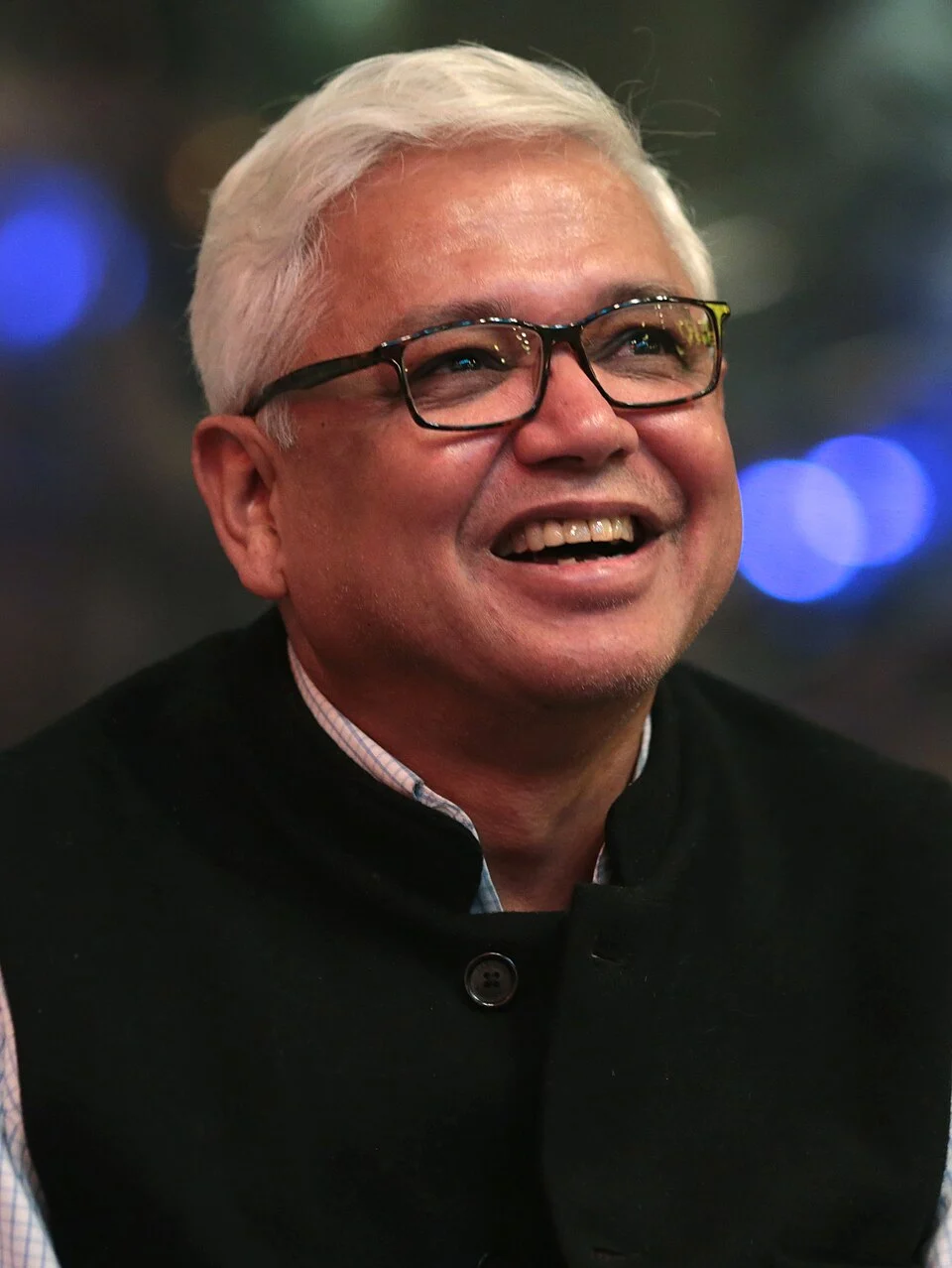
1956–
Amitav Ghosh
Novelist, essayist and writer on history and climateAmitav Ghosh connects individual lives to migration, empire, trade and ecological change through novels, historical research, travel and essays.Read biographyQuick answers
Common questions
- Why does the novel move backwards and forwards?
- The narrator reconstructs knowledge through memory and other people’s accounts. The order in which he learns matters alongside the order of events.
- Does the title mean national borders have no effect?
- No. The novel questions how divisions are made while showing that they can organise real fear and violence.
- Is Dhaka in India in the 1964 story?
- No. It was then in East Pakistan and is now the capital of Bangladesh. Calcutta, London and Dhaka must not be collapsed into a single-country setting.
Primary and institutional sources
How this history was checked
Uses the publisher-permitted opening excerpt, selected novel passages in Alessia Polatti’s study, an author essay, an educational edition record and Kirkus criticism. No complete new novel reading, lengthy quotation or cover reproduction is claimed. This article was reviewed on 23 October 2026.
- Houghton Mifflin Harcourt / AbeBooksOpening pages, explicitly reprinted by permission
- John Murray PressPublisher synopsis and 2011 edition
- Alessia Polatti / NuBEFinding Home in The Shadow Lines: selected text and analysis
- Oxford University Press IndiaEducational edition and two-part structure
- Kirkus ReviewsMemory, chronology and the 1989 Viking edition
- Amitav Ghosh / The New YorkerThe Ghosts of Mrs Gandhi: an author’s account of intention
- Wikimedia Commons / Gage SkidmoreLater complete portrait and explicit CC BY-SA grant