
The short answer
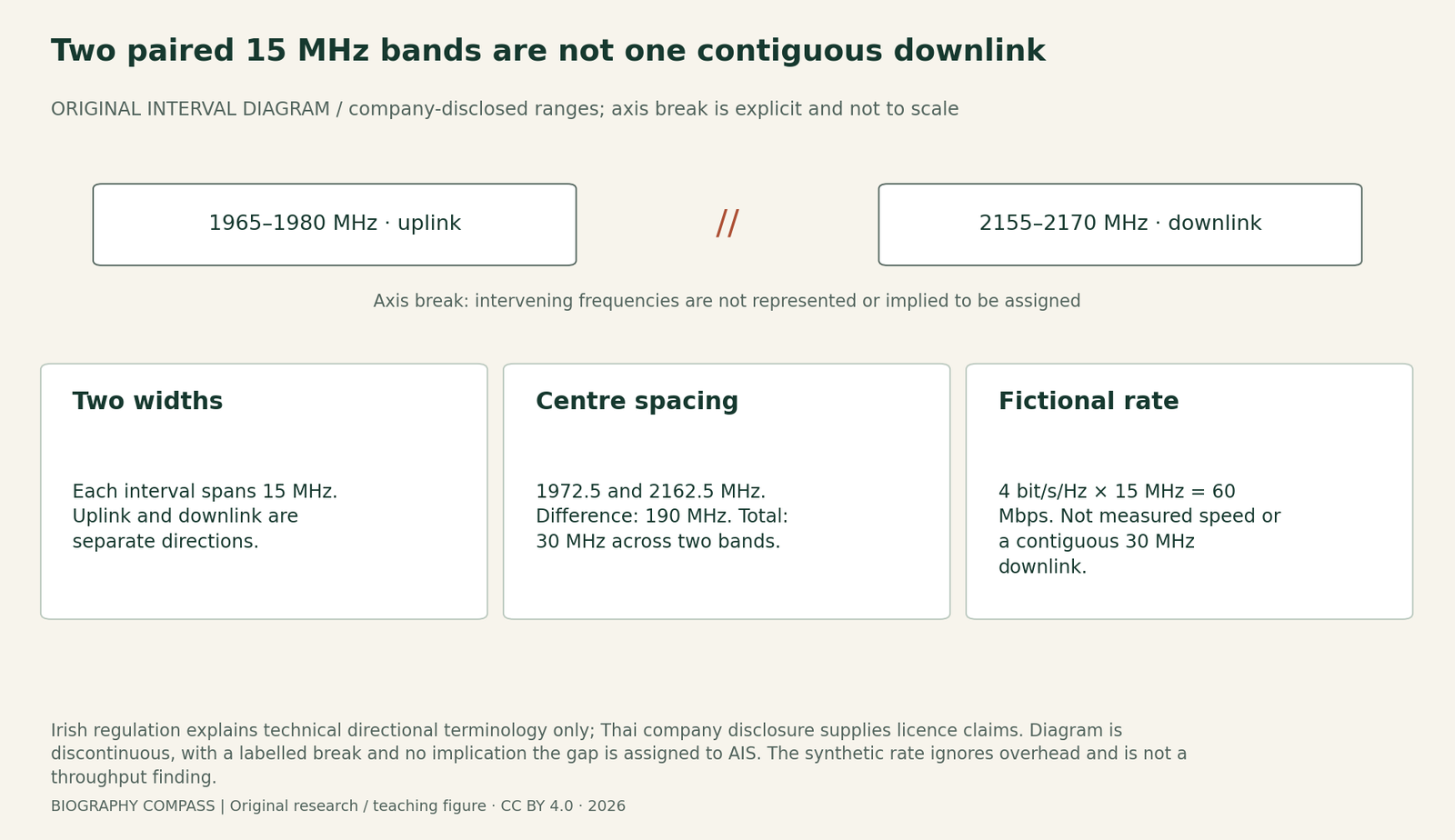
A spectrum table may write a right as 2 × 15 MHz. That notation preserves a pairing which disappears if it is casually rewritten as one continuous 30 MHz block. AIS’s 2025 report supplies exact ranges, allowing an original diagram to show what is paired, where the gap lies, and what the table cannot tell us about customer speed.
Compare the evidence
What each record can establish
Keep the quantity, institution and historical scope attached to the statement.
| Record or example | Evidence supplied | Limit on the inference |
|---|---|---|
| 2025 company report | Exact paired intervals and licence term. | It is not a customer throughput measurement. |
| Irish technical conditions | Uplink/downlink terminology and 190 MHz separation. | No Thai licence is granted by this foreign instrument. |
| 2021 company table | An earlier reported right and conditions. | Do not silently replace its dates with a later acquisition. |
Chronology
A timeline of the turning points
Earlier licence grant
Date of the 2100 MHz right reported in the 2021 table.
Historical portfolio table
Retain its own grant and scheduled-expiry fields.
New reported licence term
2025 report gives a term ending 3 August 2040.
Begin with the exact 2025 ranges
AIS’s 2025 annual report describes acquisition of a 2100 MHz licence covering 1965–1980 MHz paired with 2155–2170 MHz. Each interval is 15 MHz wide. Together they comprise 30 MHz of spectrum across two separated intervals, not one continuous interval from 1965 to 2170 MHz. The report gives a fifteen-year licence effective 4 August 2025 to 3 August 2040.
The label “2100 MHz” names the band family; it is not a claim that all transmission occurs at precisely 2100 MHz. The detailed ranges and the paired notation carry more information than that shorthand. The acquisition is reported within the corporate business, rather than as a personal asset of the chief executive.
Sources for this section: [1]
Identify the two directions without importing a licence
Frequency-division duplexing separates directions by frequency. For the 2.1 GHz band, the technical conditions in Ireland’s published 2020 instrument identify terminal transmission, or uplink, within 1920–1980 MHz and base-station transmission, or downlink, within 2110–2170 MHz. The corresponding separation is 190 MHz. AIS’s disclosed ranges sit within those lower and upper intervals.
The Irish instrument is used here only to explain that technical terminology. It does not allocate Thai spectrum or establish AIS’s rights: the Thai company disclosure supplies the licence information. This division of evidence is useful because a technical definition and a particular operator’s legal permission answer different questions.
A licence table is a dated portfolio record
AIS’s 2021 report lists a 2100 MHz right with 2 × 15 MHz bandwidth, granted on 7 December 2012 and scheduled to expire on 6 December 2027. It separately lists 1800 MHz rights with their own grant dates and terms. The 2025 report records another 2100 MHz acquisition and term. The shared band label does not make every row the same legal right.
A comparison must retain the reporting year, grant date and exact frequency range where provided. The 2021 table alone cannot establish the complete portfolio or status in October 2026. Nor should its older expiry be substituted for the separate 2025 term. A complete legal reconciliation would require the underlying grant instruments and any amendments, which were not inspected here.
Exercise: draw the pair and reject the shortcut
For the disclosed 2025 ranges, calculate each width, the centre of each interval and the separation of those centres. Draw two labelled bars, retaining the break between them. A fictional analyst then writes “AIS acquired a continuous 30 MHz downlink channel delivering 30 Mbps.” Identify the two unsupported steps in that sentence.
As a second, purely fictional test, suppose a simplified downlink model carries 4 bits per second per hertz across all 15 MHz. Ignore overhead and all other limitations only for this model. Calculate its idealised rate. Explain why this result cannot become a measured AIS customer speed, even though the arithmetic is well defined.
Reference answer: widths are not bit rates
The lower interval has width 1980 − 1965 = 15 MHz and centre 1972.5 MHz. The upper interval has width 2170 − 2155 = 15 MHz and centre 2162.5 MHz. Their centre separation is 190 MHz. The bars represent lower-band uplink and upper-band downlink within the cited technical band convention; neither bar is 30 MHz wide.
The fictional sentence first erases the pairing and then equates a frequency width with a data rate. In the simplified model, 4 bit/s/Hz × 15,000,000 Hz = 60,000,000 bit/s, or 60 Mbps. This is a stipulated ideal calculation, not a reported network measurement. Real throughput would require evidence about technology, modulation, coding, overhead, scheduling, aggregation and radio conditions. The company’s licence table supplies none of that performance test.
Continue the chronology
Related history guides
Why does one plant have several power figures?
Read Gulf NC’s 2018 electricity and steam announcement, then separate installed capacity, delivered output and ownership in a worked engineering exercise.
Read the timeline2022–2025 records · distinct operating permissionsDoes an airline certificate cover its airport?
Compare Bangkok Airways’ airline certificate with Samui’s aerodrome record and 2025 transfer, then test who holds each permission and what it covers.
Read the timelineBiography context
Explore Thailand through connected lives
Somchai Lertsutiwong
His career illustrates professional management through changing mobile technologies, broadband services and a separately dated succession of company leadership.
Explore the biographiesBiographySarath Ratanavadi
His career shows how engineering projects, partner companies and corporate reorganisations connect the electricity and communications sectors.
Explore the biographiesConnected biographies
People connected with this history
1962—
Somchai Lertsutiwong
Former AIS chief executive and telecommunications managerSomchai Lertsutiwong rose through wireless and marketing management to lead AIS from July 2014 until his retirement in November 2025.Read biography
Business career from 1994
Sarath Ratanavadi
Engineer and Gulf business organiserSarath Ratanavadi built a career in Thai power projects before leading the Gulf businesses into telecommunications and digital infrastructure.Read biographyQuick answers
Common questions
- Is the paired total 30 MHz?
- Across the two intervals, yes. It remains 15 MHz in each separated direction, rather than a continuous 30 MHz downlink block.
- Does MHz specify download speed?
- No. MHz describes frequency width; a data rate needs further technical assumptions or measurement.
Primary and institutional sources
How this history was checked
Selected primary records and identified company-linked publications support this historical comparison. Fictional exercises are labelled, and each source retains its historical context. This article was reviewed on 28 October 2026.