
The short answer
Why can a company hold a large interest in one licence without owning the same percentage of a field spanning two areas? Follow the documents before adding the percentages.
Original source comparison
Match the record to the question
Names, quantities and conclusions retain their documentary scope.
| Country | Supported interpretation | Limit |
|---|---|---|
| OPL 216 interest | Famfa history gives 60/32/8 at the 1998 licence stage. | Not automatically the later unit allocation. |
| Unit operation | Chevron affiliate operates; different concessionaires and partners are named. | Operator does not mean sole owner. |
| First-oil release | An achieved event and a projected end-2009 volume. | Forecasts are not a daily production record. |
| 2012 judgment | Legality of the challenged government acquisition. | Not a complete current field-interest register. |
Chronology
A timeline of the turning points
OPL 216
Famfa records award of the prospecting licence.
Technical partners
Participating interests change within the licence arrangement.
Lease and unitisation
Conversion and combination address different stages.
First oil
Contemporary operator release records production beginning.
Judgment
The Court addresses the disputed acquisition process.
A company history begins with one licence area
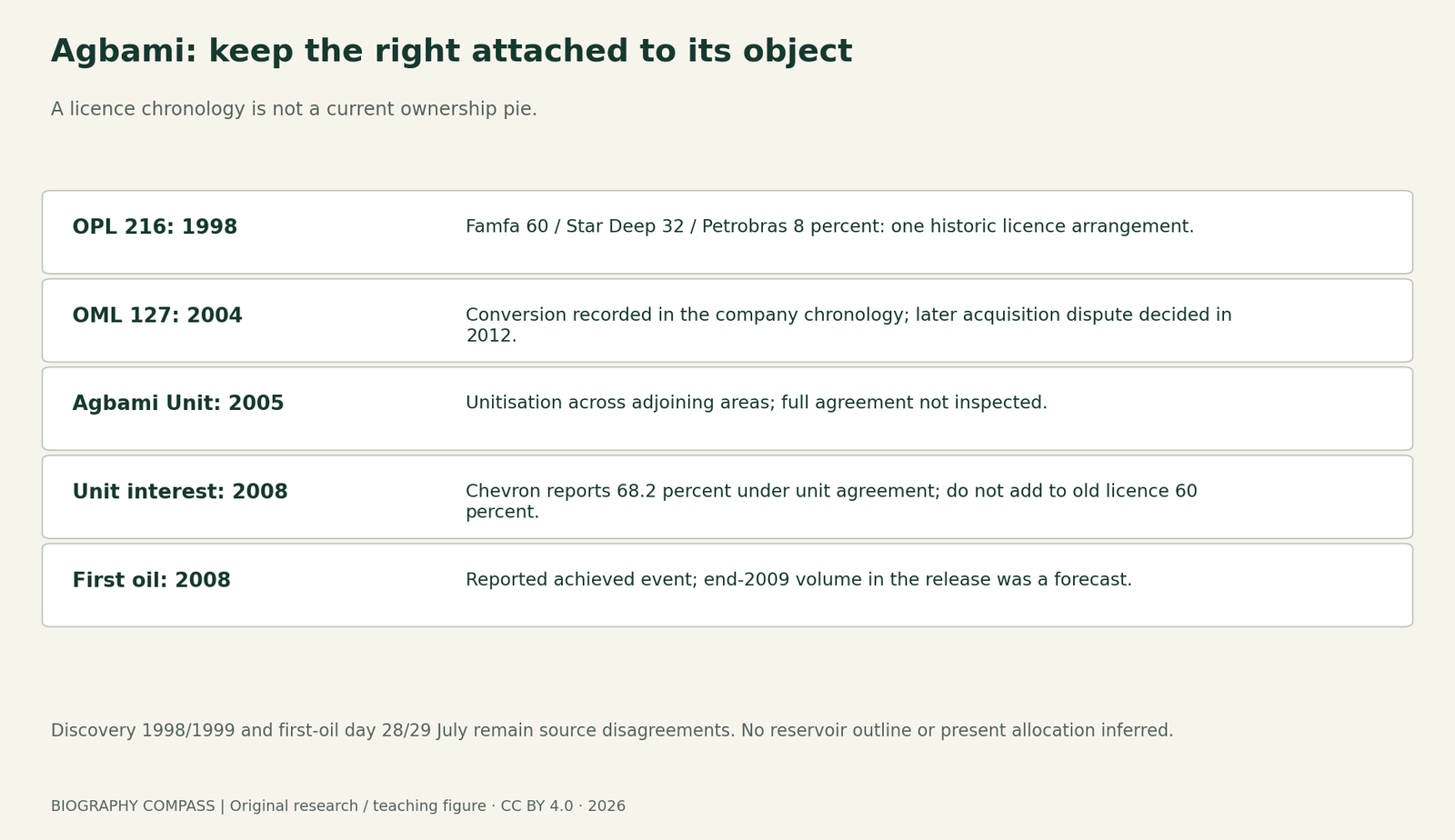
Famfa’s chronology starts with the company’s 1991 formation and the award of OPL 216 on 10 August 1993. It records a 1996 assignment of a 40 percent participating interest to Star Deep Water Petroleum, followed in 1998 by Petrobras joining with 8 percent. The history then lists Star Deep at 32 percent and Famfa retaining 60 percent. These statements concern the participating interests in that licence arrangement at identified stages. They do not state that the same percentages apply to the whole Agbami reservoir after combination with an adjoining area. Begin the research ledger with the object to which each percentage belongs.
Sources for this section: [1]
A reservoir crossing a boundary requires a wider arrangement
The company identifies the reservoir as extending across OPL 216 and OPL 217. Its history records conversion of OPL 216 to OML 127 in 2004 and a unitisation agreement in February 2005 between the licence holders. The second area brought another set of parties. Unitisation addressed a physical resource extending beyond a licence boundary. It should not be described simply as one company selling the same block again. A diagram can show two areas contributing to one development without inventing their exact geographic outline or the complete allocation formula. The consulted chronology does not reproduce the full unit agreement.
Sources for this section: [1]
Operator, concessionaire and partner are different roles
Chevron’s 31 July 2008 first-oil release names Star Deep Water Petroleum as operator of the Agbami Unit. It lists Famfa and the Nigerian National Petroleum Corporation as concessionaires, and identifies other corporate partners. Chevron reports a 68.2 percent interest under the unit agreement. That unit-level percentage cannot be added to Famfa’s earlier 60 percent licence-level figure to test whether the figures total 100. They belong to different objects and stages. Nor does being operator mean owning every participating interest: operational responsibility, concession rights and economic participation need their own labels and agreements.
A dated release separates a result from a production forecast
Chevron says first oil was achieved on 29 July 2008 through a floating production, storage and offloading vessel. It expected initial production above 100,000 barrels per day and projected 250,000 barrels of crude oil and natural gas liquids per day by the end of 2009. First oil is a reported achieved event. The later volume is a forecast in this release, not a measured daily series. The release also distinguishes potentially recoverable resources from terms permitted for proved-reserve reporting in SEC filings. Do not turn its 900 million-barrel resource estimate into a newly audited proved reserve or a guaranteed amount of oil available to one shareholder.
Sources for this section: [2]
The sources preserve narrower date disagreements
Famfa’s history and operations material use a 1999 discovery label, whereas Chevron’s contemporary release gives 1998. A Famfa tenth-anniversary account also uses 28 July for first oil, while the Chevron release and another Famfa operations page use 29 July. A careful overview can retain the common 2008 production year and attach the day discrepancy to the documents rather than choose an unexplained compromise. No drilling logs or dated completion record were independently acquired here. The disagreement does not erase the development sequence, but it prevents an exact date from appearing more secure than the evidence permits.
A corporate rights dispute is another part of the history
The 4 May 2012 Supreme Court judgment in NNPC and another v. Famfa Oil, read in a published transcription, addresses the government’s acquisition of a 50 percent interest in OML 127. The reasoning recognises government participation but requires the legally prescribed process, including negotiation. The Court rejected the challenged acquisition, dismissed the main appeals and allowed the cross-appeal. The judgment concerns the licence-interest dispute and the acquisition’s legality. It does not establish every party’s present-day Agbami percentage or declare that government participation is always forbidden. Its holdings must remain distinct from the parties’ arguments reproduced earlier in the text.
Sources for this section: [3]
Exercise: build a rights-and-events ledger
Create rows for OPL 216, OML 127 and the Agbami Unit. Add columns for date, type of right, named party, percentage if stated and source. Place the 1998 licence percentages and Chevron’s 2008 unit percentage in their proper rows. Then mark first oil as a reported event and the end-2009 volume as a forecast within the 2008 release. Finally repair this invented caption: “Folorunso Alakija alone owned 60 percent of every Agbami barrel and personally operated the field.” Identify what additional agreements and production-allocation records would be needed to investigate a particular company’s economic entitlement.
Reference answer: a precise object resolves the apparent contradiction
The 60 percent figure belongs to Famfa’s account of its licence arrangement, not to Alakija’s personal ownership of the whole field. Chevron’s 68.2 percent belongs to the unit agreement described in 2008. The operator was its affiliate, while Famfa was a concessionaire within a wider partnership. A repaired caption can describe Alakija’s leadership in a family company participating in the development and name the operator separately. Current entitlements would require dated agreements and allocation records, not subtraction from a historic percentage on another basis. The same ledger keeps a successful start-up event, a later forecast and a judicial decision from becoming one undifferentiated claim of ownership.
Connected biographies
People and institutions

1951–
Folorunso Alakija
Businesswoman, fashion entrepreneur and philanthropistFolorunso Alakija moved from office administration and banking into fashion, printing and a family oil business. Her career links personal enterprise with partnerships, a contested petroleum interest and institutional philanthropy.Read biographyQuick answers
Common questions
- Can the 60 percent and 68.2 percent be added together?
- Not meaningfully here: one describes a licence arrangement and the other a later unit-level interest.
- Was the original court file inspected?
- No. Selected reasoning, disposition and concurrences were read in LawCare Nigeria’s reproduced judgment, whose documentary status is explicit.
Primary and institutional sources
How this history was checked
Read the named contemporary disclosures beside later participant accounts; the exercises and diagrams are original editorial work. This article was reviewed on 27 October 2026.
- Famfa Oil LimitedFamfa Oil: corporate history and licence chronology
- Chevron CorporationChevron Announces First Oil Production from Agbami Field, 31 July 2008
- Supreme Court of Nigeria / LawCare Nigeria transcriptionNNPC and another v. Famfa Oil Limited, Supreme Court, 4 May 2012: reproduced judgment
- Famfa Oil LimitedFamfa Oil: founders and company overview