
The short answer
The 2012 contest required more than selecting a prominent diplomat. An inconclusive vote, a renewed ballot and a transition between administrations preceded Nkosazana Dlamini-Zuma’s assumption of office. The sequence also explains why chairing the Commission was different from holding the African Union’s rotating political chair.
Chronology
A timeline of the turning points
No winner
Neither Ping nor Dlamini-Zuma secures the necessary majority.
A decisive ballot
Dlamini-Zuma wins the Commission chairperson election.
Transition discussions
Ping meets the chairperson-elect and introduces senior collaborators.
An incoming administration
Election does not mean an immediate same-day transfer of responsibilities.
Handover
The incoming chairperson addresses the institution in Addis Ababa.
January demonstrated the difference between support and a winning majority
The first contest placed incumbent Jean Ping of Gabon against South Africa’s home affairs minister. Neither obtained the required two-thirds majority. Contemporary VOA reporting described closed-door negotiations and uncertainty about the next election, rather than an already settled succession.
That result matters because a leading candidate is not necessarily an elected office-holder. The institution needed a process that could produce the required majority, while its existing work continued. Reading January backwards from July’s outcome would erase both the uncertainty and the effort needed to resolve it.
July settled the election without merging two distinct offices
At the Addis Ababa summit on 15 July, Dlamini-Zuma defeated Ping and won 37 votes in the final round. VOA’s contemporary report separately identifies Benin’s President Thomas Boni Yayi as holder of the AU’s rotating chair. The distinction was visible even in the reporting of the victory.
The Commission chairperson was not becoming a continental head of state. Nor was this a direct election by African citizens. Heads of state and government selected an institutional executive through the AU’s procedures. The historic first for a woman therefore concerned a specific office, whose responsibilities should be named accurately.
The transition separated election from taking over the administration
The AU’s 16 July release describes Ping receiving the chairperson-elect at headquarters, introducing his close collaborators and discussing a transition expected to last no more than ninety days. It supplies a practical intermediate step between a ballot and the later handover.
Dlamini-Zuma’s 15 October address names Ping as outgoing chairperson and acknowledges the commissioners and staff whose work she would build upon. An organisation does not begin again when its leader changes. The sequence makes continuity, personnel and the transfer of responsibilities visible alongside the more memorable election result.
Commission leadership carried administrative and coordinating obligations
The AU’s later handbook explains the Commission chairperson’s executive, legal and accounting responsibilities. Its account includes administration, staff, budgets, reporting and coordination with member governments and regional institutions. These functions explain why the post involved sustained institutional work rather than ceremonial representation alone.
The handbook is a later description, not a claim that every detail of the 2021 structure already applied in 2012. The useful distinction is between leading the Commission and controlling member states. Continental coordination depended on governments, other organs and staff; the election did not place all African executive power in one person’s hands.
Sources for this section: [6]
The gender milestone created a mandate, not evidence of completed equality
In her July acceptance speech, Dlamini-Zuma connected the result with women’s participation and Southern Africa’s opportunity to lead the Commission. She also emphasised cooperation across member states, education and young people’s prospects. These are the priorities the incoming leader articulated, not independently demonstrated outcomes.
Her October opening remarks likewise presented the task as collective work with commissioners and employees. The election’s significance can therefore be assessed on two levels: entry into an office previously held by men, and the later exercise of that office. A historic appointment is consequential without being treated as proof that every institutional or social objective was achieved.
Continue the chronology
Related history guides
Biography context
Explore Addis Ababa, Ethiopia through connected lives
Connected biographies
The incoming chairperson’s wider public career
1949–
Nkosazana Dlamini-Zuma
Medical doctor, former cabinet minister and African Union Commission chairpersonNkosazana Dlamini-Zuma moved from medical training and anti-apartheid exile into South African cabinet service and continental administration. Her career includes contested health decisions, a prominent Home Affairs record and election as the African Union Commission’s first woman chairperson, followed by renewed domestic political responsibilities.Read biographyQuick answers
Common questions
- Was the election the same event as the handover?
- No. The decisive vote was in July; the formal handover was on 15 October 2012.
- Did she replace Boni Yayi as the rotating AU chair?
- No. That was a separate office. She succeeded Jean Ping at the Commission.
- Did African citizens vote directly in this contest?
- No. The record identifies an election by African heads of state and government.
- Was this event in South Africa?
- No. The election and handover discussed here took place in Addis Ababa, Ethiopia.
Primary and institutional sources
How this history was checked
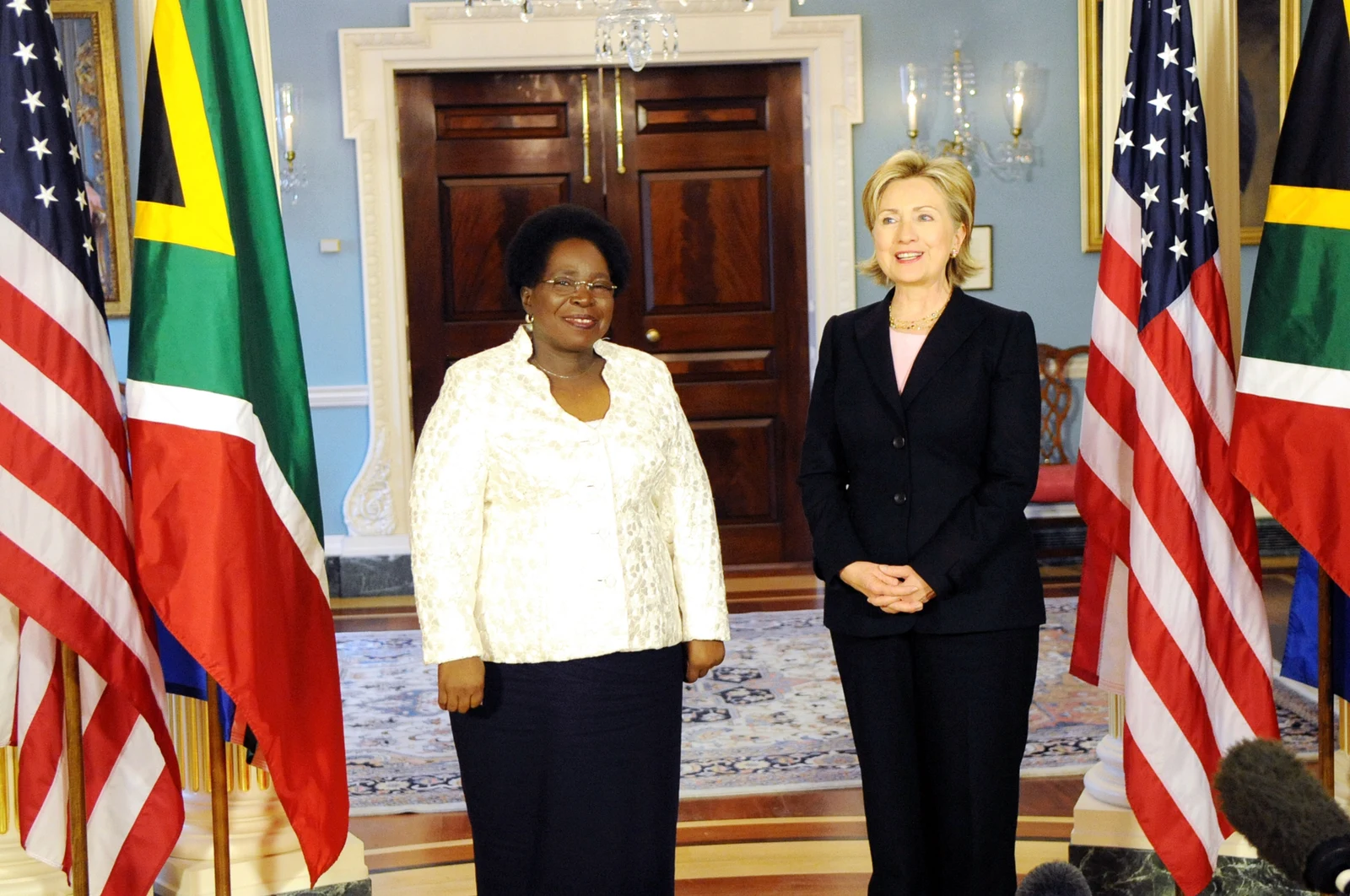
Contemporary election coverage, the transition release and selected speech passages were read. Only the handbook’s relevant Commission pages were used, not its entire institutional survey. The 2009 State Department photograph identifies Dlamini-Zuma; it does not depict this election. This article was reviewed on Reviewed 24 October 2026.
- Voice of America30 January 2012: AU leadership race ends without a winner
- Gabe Joselow / Voice of America15 July 2012: Dlamini-Zuma elected Commission chairperson
- African Union Commission16 July 2012: Ping receives the chairperson-elect
- Nkosazana Dlamini Zuma / African Union16 July 2012 acceptance speech: selected representation and cooperation passages
- Nkosazana Dlamini Zuma / African Union15 October 2012 handover address: opening three pages
- African Union Commission and New Zealand MFATAfrican Union Handbook 2021: selected Commission functions, pages 94–95
- U.S. Department of State / FlickrSecretary Clinton meeting Dlamini-Zuma, 19 March 2009