
The short answer
What can a programme tell us about the making of a national theatre? The Abbey’s opening records reveal a changing bill, unevenly visible labour and the difference between a printed object and one evening’s performance.
Original evidence comparison
An evening, an object and a production list
Preserve the unit of evidence before combining the records.
| Country | Object or decision | Useful evidence | Further research |
|---|---|---|---|
| Opening history | Three plays, Fay, Allgood and Horniman’s contribution. | A specific event described retrospectively. | Contemporary audience responses and financial accounts. |
| Programme catalogue | A 1904 object describing the run and changing third play. | Scheduling and the visibility of particular credits. | Inspect programme pixels and compare surviving copies. |
| Production database | Premiere fields and separately listed productions. | Dates, venues and counted performances. | Do not turn performance counts into attendance. |
| Scholarly biography | Gregory and Yeats co-authored Kathleen ni Houlihan. | Context for an attribution abbreviated in a programme description. | Drafts and correspondence would develop the collaboration history. |
Chronology
A timeline of the turning points
An opening bill
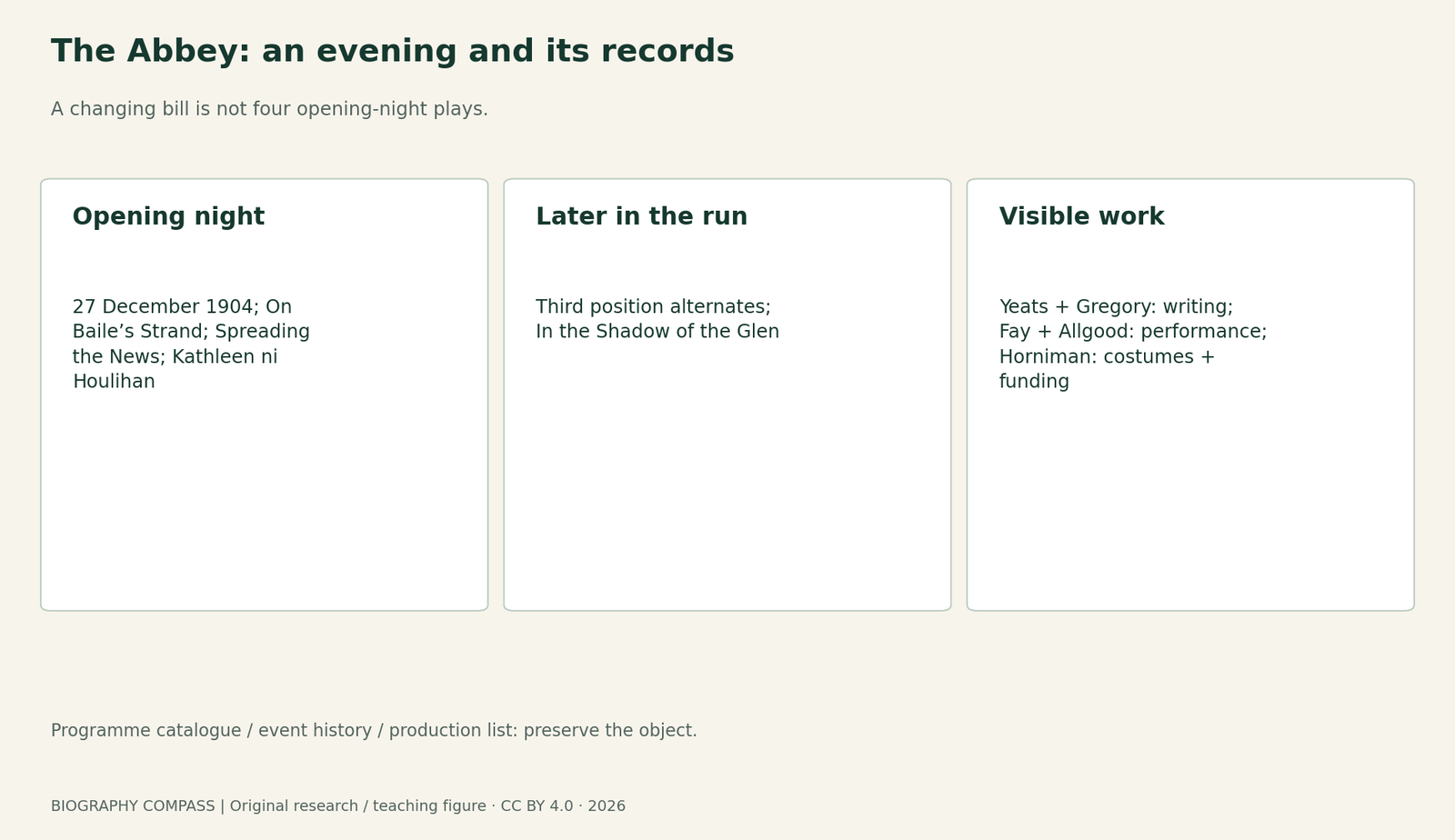
On 27 December, three one-act plays mark the theatre’s opening.
A changing third play
The programme catalogue describes alternation during the remaining run.
Touring records
The archive lists separate November touring engagements for On Baile’s Strand.
Ask which evening a programme describes
Start with a narrow question: which three plays were performed on the Abbey’s opening night, and which titles belonged to the wider run? The Abbey’s catalogue description of its 1904 programme and its anniversary history answer these questions together. A printed theatre programme can announce a season, a run or a single performance; its printed list should not automatically be treated as a report that everything listed happened on one night. Here the institutional description explicitly separates the opening from subsequent alternation. Recording that distinction makes the theatre’s beginning a recoverable event instead of a loose group of famous titles.
Reconstruct the bill before interpreting the theatre’s ambitions
The anniversary account gives the opening sequence as On Baile’s Strand, Spreading the News and Kathleen ni Houlihan. The programme description adds that the third position alternated later with Synge’s In the Shadow of the Glen. Make two headings in a research note: opening night and remainder of run. Put each work under the appropriate heading, allowing one title to recur. This prevents a four-title programme from becoming a claim that four plays opened the theatre. The small scheduling distinction also changes a larger interpretation: the first public presentation was a particular selection from a developing repertoire.
A national theatre began through several kinds of work
The opening account names Frank Fay as Cuchulain, speaking the first words on stage, and Sara Allgood as a performer in all three plays. It also identifies Annie Horniman’s costumes and financial support for the building. Yeats’s presence as playwright and organiser is therefore one part of the event. A useful history should make a sentence’s verb fit the responsibility: wrote, performed, designed, financed or managed. These actions are related, but combining them all into founded or created erases the practical structure that made a performance possible. Begin with named roles before estimating anyone’s influence.
Sources for this section: [2]
The catalogue exposes an uneven pattern of credit
The Abbey’s programme description says Horniman’s costume-design credit is the only such credit listed. That observation raises an interesting question about visibility. Which work was made public on the object, and which work needs other records to become visible? The answer cannot be supplied by counting the names of writers alone. Nor should a missing credit be immediately converted into a claim that a task was not done. Treat the object as one institution’s arrangement of information for its audience. Its choices about naming labour can themselves become a historical subject, provided the evidence remains attached to this particular programme.
Sources for this section: [1]
Author attribution can change between records
The opening catalogue attributes Kathleen ni Houlihan to Yeats, while the Dictionary of Irish Biography identifies it as co-authored with Lady Gregory. Keep both pieces of information in view: one records the attribution carried by this object’s description, the other supplies a later scholarly account of collaboration. Silently replacing the programme attribution would conceal a feature of the record; silently repeating it as exclusive authorship would conceal Gregory. A clear caption can state what the programme description says and then identify the co-authorship separately. This is a productive comparison between evidence objects, rather than a reason to discard either entire source.
Use the database to distinguish a play from a production
The Abbey’s On Baile’s Strand page gives a premiere date and venue, followed by a list of productions. Its 1904 production is associated with seven performances. Four November 1905 touring records appear separately, each with its own opening date and count. Those fields help map circulation, but the word performance is a unit of event counting, not a measure of audience size or artistic quality. Copy the relevant row with its label before using a number. Combining rows may be useful for a defined question, but the researcher must first decide whether the subject is one production, one year or a play across many years.
Sources for this section: [4]
Exercise: prepare a caption with visible collaborators
Draft a ninety-word museum caption for the opening. Require it to contain the date, the three-work bill, one performer and Horniman’s material contribution. Then draft a second caption for the programme as an object. In that version, explain that its run includes an alternating third play and distinguish the object’s writer attribution from the scholarly co-authorship account. Compare the two captions with a partner: which information belongs to the evening, and which belongs to the evidence used to reconstruct it? Underline any sentence that slips from a listed role into a claim about someone’s unrecorded intentions.
Reference approach: make the comparison do historical work
A successful event caption can name Yeats and Gregory beside Fay or Allgood and the benefactor who enabled the venue. The object caption should explain alternation without adding Synge to the opening-night bill. Neither needs to invent the audience’s reaction. For an extended project, list the further evidence needed to study reception: dated reviews, correspondence, financial records or a witness’s account. Match each proposed source to a precise question. A newspaper review might describe a critic’s response, while accounts might help investigate expenses; neither should be asked to replace the other. The aim is a richer description of cultural work, not a longer roll of famous names.
Continue the chronology
Related history guides
Biography context
Explore Ireland through connected lives
Connected biographies
People in the evidence
1865–1939
W. B. Yeats
Poet, playwright and theatre organiserW. B. Yeats developed from a poet of legend and symbolic longing into a restless modern writer. Theatre, family collaboration and public argument shaped his changing art.Read biographyQuick answers
Common questions
- Did four plays open the Abbey in 1904?
- The opening-night account gives three. Synge’s In the Shadow of the Glen alternated with Kathleen ni Houlihan later in the run.
- Was the original programme image fully read here?
- The Abbey-authored object catalogue and description were read. The high-resolution programme pixels were not inspected.
Primary and institutional sources
How this history was checked
This guide reads the complete Abbey-authored programme catalogue description, the opening-night anniversary account and production database fields. It compares attribution with the scholarly Yeats biography. The plays, high-resolution programme and original financial or audience records were not inspected. This article was reviewed on 27 October 2026.
- Abbey Theatre / Google Arts & CultureProgramme of opening night performances at the Abbey Theatre, 1904
- Abbey TheatreAbbey Theatre opens its doors, 27 December 1904
- Royal Irish Academy / Dictionary of Irish BiographyYeats, William Butler, Terence Brown, 2016
- Abbey Theatre ArchivesOn Baile’s Strand: premiere and production record